
Standardized RGB to Normalized RGB
Introduction
Color has a hidden complexity that most people never see and, more accurately, do not understand. It is not an aesthetic choice for a display screen. It is, in fact, the only physical signal derived from raw RGB that spans natively across three separate dimensions — the physical world, the digital layer, and the machine‑native semantic substrate.
Across the world, thousands of physical color specification systems exist — paint decks, textile swatches, plastics standards, print libraries, industrial coatings, and more. Each uses its own naming conventions and random identification codes to identify physical swatch colors that rarely match. This creates “color chaos” across the entire product ecosystem.
In 1996, Microsoft and Hewlett‑Packard introduced a color model called sRGB (Standard Red Green Blue) to standardize color display on analog CRT monitors across the early worldwide web. As technology progressed, CRT monitors were replaced with digital LCD screens, but raw RGB values remained the universal means to display color on a device. This created a need to apply color to web‑based digital content — a need that physical color tools could not meet.
The color chaos existed long before the introduction of internet, but the digital layer created an unmanageable problem that still exists today. It can be fixed.
Standardized RGB (sRGB)
The sRGB color space was converted into a coordinate system mapped to the same gamut. The sRGB color picker, like CRT monitors, was mapped to 8‑bit channels for Red, Green, and Blue (0–255 per channel), producing 16,777,216 fixed, equidistantly mapped coordinates. Where the R, G, and B values intersect (x‑y‑z) provides a numeric position within the cube — a coordinate that can be stored, transmitted, and displayed. After 30 years, the sRGB color picker still remains the default “digital box of crayons” used to apply color to web content to this day.
All print systems must be converted to sRGB to display color content on a digital device. That is how color chaos is introduced into the digital layer. Subtractive print systems do not convert properly into additive digital systems, and this unresolved mismatch creates persistent problems for online shoppers — driving significant return rates and costly restocking cycles across apparel, cosmetics, home goods, and décor.
This same problem extends directly to the integration of AI into the digital layer. Machines, unlike humans, cannot “see” color. Artificial Intelligence (AI) receives only numeric tensors and currently relies on inconsistent, subjective human labeling to map and identify color data. The sRGB coordinate model, however, is far too random and redundant for this purpose. Every LLM, multimodal vision transformer, and autonomous agent is operating inside a high‑entropy digital substrate. We push models to achieve millimeter‑accurate spatial awareness or hyper‑precise target recognition, yet we feed them ungrounded, device‑dependent data corrupted at the absolute source.
Addressing this issue requires a smaller, more efficient subset that combines objective, physics‑aligned color data for AI with stable, intuitive visualization for the human eye.
Digital Color Calibration
Color calibration is the process of fine‑tuning a monitor to accurately display colors and shading. The goal is simple — measure and adjust a device’s color response so it aligns with a known, stable reference. Outside of specialized verticals like medical imaging, the tech industry has attempted to achieve calibration for decades without much success.
The human eye is remarkably adaptable. When a color shifts across different screens, our biological visual system automatically compensates. Because of this, the tech industry stopped prioritizing hardware calibration around 2015, defaulting to “good enough” automated software profiles like standard sRGB and ICC loops. If a color shifted slightly between your phone, your laptop, or your monitor, your brain corrected it instantly.
But in 2025, everything changed. The industry began injecting advanced Artificial Intelligence directly into the digital layer and made a fatal architectural assumption. It assumed that a machine could interpret data through the same uncalibrated display window humans use. It can’t. Machines do not have biological brains to auto‑correct drift. To an AI’s mathematical weights, device-dependent legacy1996 sRGB noise, floating‑point rounding error, and device‑profile variance are not aesthetic mismatches — they are toxic digital static. They force the model to guess the context behind the pixels, triggering immediate token drift, semantic instability, and unnecessary processing latency.
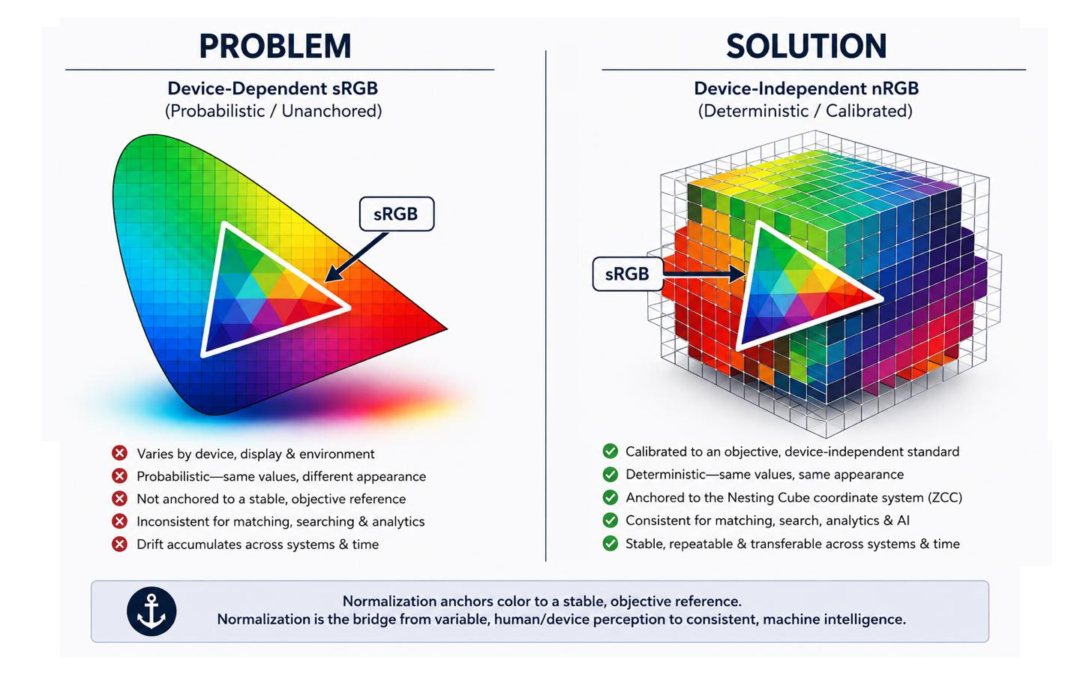
The solution is not to teach machines to “appreciate” or approximate probabilistic human color. The solution is to leverage the machine’s true nature as a deterministic computing engine. sRGB and ICC profiles are the wrong tools for this task. Digital color calibration requires a normalized, device-independent coordinate system.
Normalized RGB (nRGB)
This substrate physics flaw cannot be fixed with application‑layer software. That is precisely why zenColor engineered Normalized Color Calibration (NCC) and the normalized, device‑independent RGB (nRGB) standard. We did not build a color palette. We built a geometric constraint system — an unyielding vice that forces digital color into deterministic alignment.
The difference between device‑dependent sRGB and device‑independent nRGB is foundational. sRGB values drift with every change in sensor, lighting, exposure, device profile, or display pipeline. nRGB values do not drift. It remains stable across all devices, all environments, and all imaging pipelines.
The industry is currently writing complex Python code and defensive caging layers to stop AI models from hallucinating or collapsing. They do not realize that this is not a software problem. The uncalibrated devices that generate and display the digital layer are the problem. All legacy display calibration methods — Adobe RGB, Display P3, Rec.709, Rec.2020, ROMM RGB, and vendor‑specific profiles — are device‑dependent RGB encodings. None of them normalize raw RGB. All inherit the same substrate instability.
Normalized Color Calibration (NCC) eliminates drift at the structural boundary, isolating and normalizing raw RGB into nRGB to provide the first deterministic, device-independent substrate for imaging pipelines and AI scale semantic interpretation. This is the breakthrough the industry has been waiting for — and the foundation AI requires to stabilize.
Our patented system for NCC normalizes raw RGB into nRGB, providing the first deterministic, device‑independent substrate suitable for both imaging pipelines and machine‑native semantic interpretation.
Conclusion
From 1996 to 2015, the industry attempted multiple calibration methods, all built on device‑dependent RGB and all inheriting its substrate instability. By 2015, the field entered maintenance mode, having no alternative to sRGB despite knowing the system was unstable.
The breaking point arrives in 2025, when AI is integrated into the digital layer. Suddenly, the instability of uncalibrated RGB becomes catastrophic. AI does not see color — it sees numbers. And those numbers drift. Drift is not a display problem. Drift is a substrate problem. The only way to stabilize the digital substrate is to stabilize the devices that generate the substrate itself.
Normalized Color Calibration (NCC) attaches drift directly to the calibration process, normalizing raw RGB into nRGB and providing the first deterministic, device‑independent substrate for imaging pipelines and AI‑scale semantic interpretation. This is the breakthrough the industry has been waiting for — and the foundation AI requires to stabilize.
The NCC standard will be available for global distribution once strategic partners are onboard and licensing agreements are finalized. zenColor Glossary.