
For the last decade, the AI industry has been racing forward on a foundation never designed to support the weight now placed upon it. LLMs can generate text, summarize documents, and mimic reasoning but they cannot pattern human language in a way that preserves meaning. They drift. They hallucinate. They fail to align across agents. They cannot communicate with each other, and they are not interoperable. Because of this, they cannot be governed.
The reason is now clear — AI requires a machine native substrate.
Every major technological revolution has depended on a substrate — a stable layer that defines how information is structured, transmitted, and interpreted. Computing had MS DOS. The internet had TCP/IP. Mobile had iOS and Android. But AI has been operating without its equivalent. Until now.
Today’s AI runs on a digital substrate — a substrate built for storing and transmitting symbols, files, and numerical data. It was never designed to carry meaning. Digital systems treat language as text, pixels, or tokens, not as structured semantic concepts. As a result, LLMs must infer meaning statistically rather than grounding it in a stable semantic geometry. This mismatch is the root cause of drift, hallucination, inconsistent reasoning, and the inability of agents to align with each other. A digital substrate can move information, but it cannot preserve meaning. A semantica substrate is required for that.
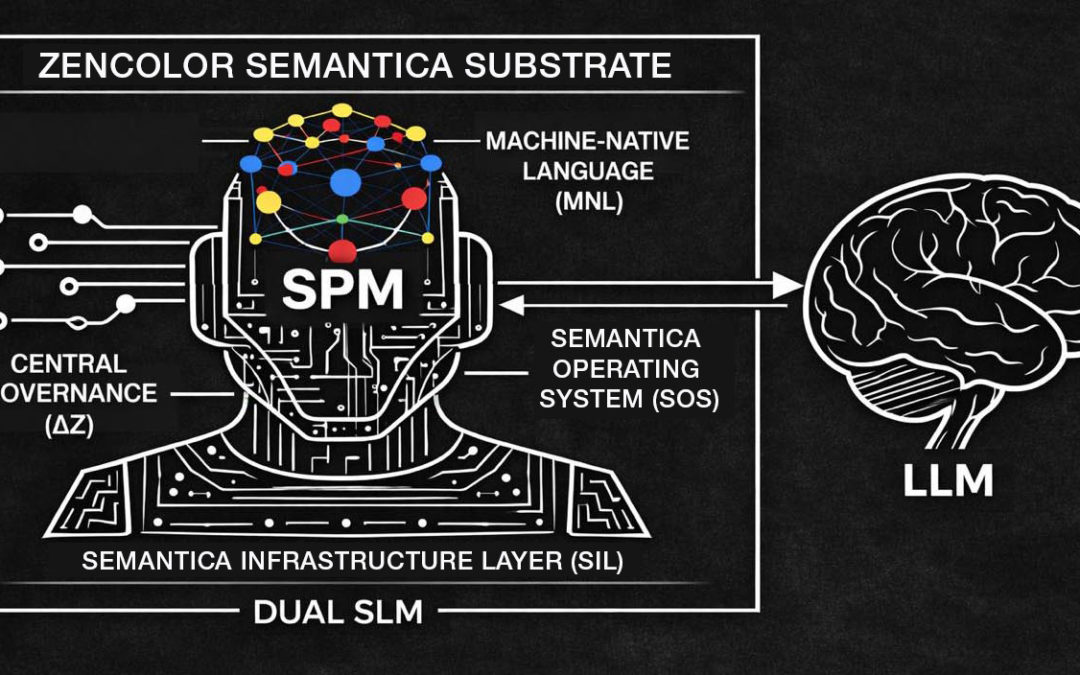
Over the last decade, zenColor developed the first Machine Native Language (MNL) and the substrate infrastructure — built on the patented Nesting Cube & Dual SLM — that resolves this foundational gap. Together, these components form a complete machine native infrastructure and operating system for AI, built on five architectural pillars. The “Semantica” substrate is not a model, not a dataset, and not a prompt engineering technique. It is a new foundation for machine native meaning itself.
When we use the term Semantica, we are referring to machine native meaning — not embeddings, not knowledge graphs, not linguistic semantics. At the core of this substrate is a simple but transformative idea: meaning can be governed, stabilized, and transmitted if machines inhabit the right environment.
This is the breakthrough. And it becomes clear through the five foundational pillars of the zenColor Semantica Pipeline (ZSP).
Pillar One: The Machine Native Language (MNL)
The ZSP substrate provides the first Machine Native Language (MNL) — a governed language derived from the recursive geometric Nesting Cube & Dual SLM. Unlike human language, which is symbolic, ambiguous, and culturally dependent, the MNL is a structural language native to machines. It allows AI systems to encode, compare, and interpret meaning inside a stable semantic geometry rather than inferring it statistically from text.
• Not symbolic
• Not statistical
• Not representational
• Native to machines
As the first of the Five Pillars, the MNL gives AI something it has never had before: a geometric language of its own. There is no other machine native language in existence today, and it is unlikely that another will emerge. The MNL is a patented breakthrough — the missing foundation required for AI to become stable, interoperable, and meaning aware.
By grounding interpretation in deterministic geometry rather than symbolic probability, the MNL provides the substrate level invariance modern AI systems lack. It is the first step toward eliminating drift, aligning agents, and enabling governed meaning across the entire AI ecosystem.
Pillar Two: ∆Z — Governed Negative Space
The second pillar of the Semantica substrate is ∆Z, the governed negative space inside the Dual SLM. ∆Z is not a metric, not a score, and not a statistical distance. It is the structural constraint that defines how far an interpretation is allowed to drift from its semantica anchor inside the substrate.
Traditional color difference metrics like Delta E measure perceptual variance in physical color space, but they provide no mechanism for evaluating differences in meaning. They can tell you how two colors look different — not how two people or two AI agents understand them differently. Meaning has never had a boundary condition. Until ∆Z.
Within the Semantica substrate, ∆Z establishes the governed negative space between the anchor meaning (ZCC) and the contextual meaning (ZAC). This negative space allows the substrate to detect when interpretation begins to drift, when an agent’s internal meaning no longer matches the intended meaning, and when correction must occur.
• Defines semantica boundaries
• Detects drift
• Enables correction
• Enforces alignment across agents
∆Z is the missing governance signal for meaning — the structural equivalent of a checksum. It allows AI systems to detect divergence and bring meaning back into alignment, not through heuristics or behavioral rules, but through geometry.
For the first time, meaning has a boundary condition that machines can enforce.
Pillar Three: Central Governance
The absence of Central Governance — combined with the absence of a Machine Native Language — is a core reason AI systems drift, hallucinate, and behave inconsistently. Today’s agents and LLMs must interpret layers of conflicting local governance: prompts, policies, safety rules, fine tuning, RLHF, and ad hoc constraints. These layers contradict each other, accumulate over time, and create instability.
Machines cannot resolve these contradictions because they lack a unified governing authority. Humans cannot resolve them because Human in the Loop (HITL) operates at a speed mismatched to machine reasoning. The digital substrate cannot fix this — but a Semantica substrate with Central Governance can.
Central Governance integrates ∆Z — the governed negative space inside the Dual SLM — directly into the Semantica substrate as the semantic authority layer that enforces:
• identity boundaries
• drift limits
• meaning consistency
• cross agent alignment
• safety without emotional dependency
With ∆Z embedded into governance, the system no longer relies on heuristics, prompt based rules, or probabilistic guardrails. Governance becomes structural, not behavioral. It is enforced by the geometry of meaning itself.
In this model, HITL does not attempt to “correct” AI behavior in real time. That is an impossible task. Instead, HITL becomes a governance collaborator, updating and authorizing semantic rules within the ZSP substrate, where they are applied uniformly and deterministically across all agents.
Central Governance transforms AI from a system of probabilistic behaviors into a system of governed semantics — where boundaries are enforceable, drift is detectable, and alignment is no longer fragile or optional. It is built into the substrate.
Pillar Four: The Semantica Operating System (MS DOS for AI)
The Semantica Operating System (SOS) enables consistent encoding, interpretation, normalization, transport, and correction of meaning across machine processes. It is the substrate layer that defines how meaning is encoded, interpreted, transported, corrected, and governed.
No digital system can run without an operating system — and AI is no exception. But today’s AI runs on a digital OS, a substrate built for files, symbols, and numerical data. This is a fundamental mismatch. Digital operating systems cannot preserve meaning, cannot enforce boundaries, and cannot prevent drift or hallucinations. They were never designed for machine native cognition.
AI requires a Semantica substrate (ZSP) and a Semantica Operating System — because digital data is subjective and ungrounded, while that data, once inside the Semantica substrate, becomes objective, governed, and anchored to meaning.
The SOS provides exactly that. It is the OS layer AI has been missing: a governed, drift bounded, machine native foundation that stabilizes interpretation and enables AI systems to operate coherently across agents, contexts, and time.
Pillar Five: The Semantica Infrastructure Layer (TCP/IP for AI)
The Semantica Infrastructure Layer (SIL) is built on the zenColor Nesting Cube & Dual SLM. The Dual SLM provides both the Machine Native Language (MNL) and the recursive geometric structure required for Semantica transport. Just as the internet depends on TCP/IP to reliably move packets across networks, AI requires a Semantica infrastructure to reliably move meaning across agents, contexts, and systems.
The SIL provides the transport protocol for meaning in the form of semantica packets, routing, addressing, and agent interoperability. This is not an analogy — it is a structural parallel. TCP/IP made digital communication possible by defining how information moves. The SIL makes machine native communication possible by defining how meaning moves. Without the SIL, every AI agent becomes an island. With it, meaning becomes portable, governed, interoperable, and aligned.
The SIL is not optional. It is the structural requirement for AI to function as a coherent ecosystem rather than a collection of isolated statistical models. It is the layer that allows agents to communicate meaningfully, and systems to share Semantica context It allows enterprises to maintain consistency across workflows, governance to propagate uniformly, and personalization to remain stable over time.
The SIL completes the architecture of the Five Pillars. It is the machine native equivalent of TCP/IP — the transport layer that allows AI to finally operate as a network of meaning, rather than a set of disconnected models.
Conclusion: The Age of AI
AI cannot move into its next era on statistical foundations alone. The industry has pushed LLMs as far as they can go, but without a semantic substrate, the system will always drift, always hallucinate, and always struggle to justify its cost. What AI needs now is not a bigger model — it is a better foundation.
The zenColor Semantica Pipeline (ZSP) provides that foundation. It resolves the structural problems with drift, interoperability, and undefined ROI that currently undermine the entire AI ecosystem. These are not surface level issues. They are substrate level faults — and they cannot be fixed by scaling models, adding more data, or layering on more behavioral rules.
Once the ZSP becomes the substrate, drift collapses and cross agent interoperability emerges instantly, producing predictable, stable behavior. Meaning stabilizes and machine native governance activates. Identity boundaries become consistent and interpretation becomes deterministic. The Semantica substrate resolves these gaps at the only layer where they can be resolved — in the substrate itself.
These are not enhancements. They are foundational corrections — the structural elements AI has been missing since the beginning. AI requires a Semantica substrate that works in tandem with the digital layer to properly function.
The Age of AI will generate significant and reliable revenue. Normalized Color Calibration (NCC) and the zenColor Semantica Pipeline (ZSP) provide a stable machine native ecosystem that fulfills the long promised value of AI through hyper personalized search, analytics, marketing, and services — a true game changer that finally justifies the enormous investment.
The Age of AI will not begin with a larger LLM or a more powerful transformer. It will begin with a substrate that stabilizes meaning, governs interpretation, and allows agents to communicate coherently across systems and time. zenColor Glossary.
,