
Drift costs the hyper-scalers billions in maintenance, but it can be resolved for a fraction of the cost. Want to learn more?
AN OPEN ENGINEERING INVITATION
zenColor® SI invites Meta, Google, Nvidia, Amazon, Microsoft, Palantir, Alibaba, SpaceXSI, and other qualified companies to demo the zenColor Semantica Pipeline (ZSP) and Normalized Color Calibration (NCC) substrate in a secure, isolated sandbox under a strict Non-Disclosure Agreement (NDA), free of charge. Ten minutes to set up. No code required. Results are immediate and observable. If we are wrong, ten minutes proves it. If we are right, the industry eliminates accelerating drift and skyrocketing costs, both of which are unsustainable.
THE THREE SIGNALS OF RAW RGB
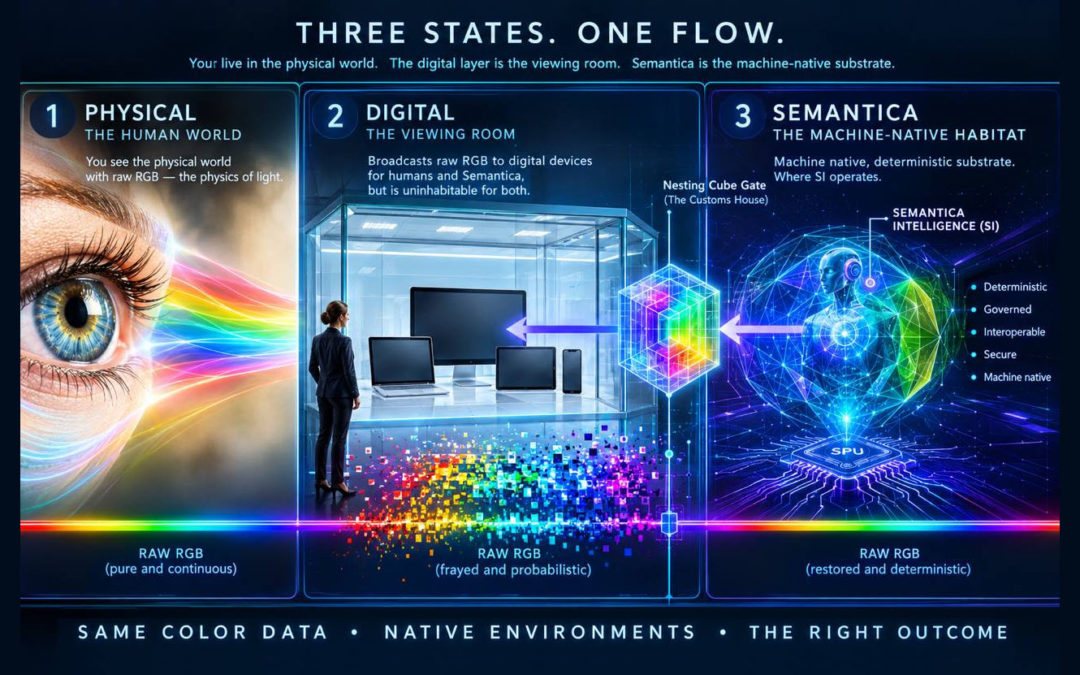
Human beings live in the physical world. While we cannot enter the Digital World, our biological eyes are used to view the content on a device. Intelligent machines have a similar situation, but in reverse. A machine cannot inhabit the digital layer, but it can also “view” and interact with the content from the machine-native, deterministic Semantica environment. Neither human beings nor machines are native to the digital layer — it is the viewing room between them, a place to view and align information, not a home for either one.
We see color in the physical world and on a device through the perceivable gamut of raw RGB that is visible to the human eye. This is often referred to as “pleasing color.” In the digital layer, however, the signal frays. As raw RGB moves through devices, applications, images, and human language, it fragments, smears, and drifts. The layer can display the signal but cannot preserve it. The signal, itself, becomes probabilistic in this layer by nature, because human expression is subjective and non-invertible.
THE MACHINE-NATIVE DIGITAL HABITAT
Raw RGB is the physics of light. It is the common denominator — the only signal that exists in all three states. It originates in the physical world as the measurable property of light, carries through the digital layer as data and, when it passes through the Nesting Cube, the signal is returned to its native state. Why does this occur? The Nesting Cube is the gate. It is a 3D “blueprint” of the raw RGB gamut that is perceivable to the human eye. The recursive geometry is a fixed, deterministic coordinate structure that returns the scattered raw RGB signal in the digital layer to its natural state — the physics of light. The geometry is not a visualization of the data. It is the coordinate system that makes the data machine-native. Inside the Semantica habitat, the signal is crisp again. This is a critical factor needed to create a machine-native, deterministic digital environment and resolve the issue of context-smearing, data rot, and parameter drift. The industry has accelerated software patches and guardrails to fix the issue but are, in fact accelerating a problem that will eventually collapse the digital floor beneath the models.
Raw RGB provides the common signal. The Nesting Cube geometry provides the deterministic coordinates. The governed boundary preserves the transition between the probabilistic digital layer and the deterministic Semantica habitat.
THE SEMANTICA ORGANISM
Recursive geometry and invariant coordinates replace the symbolic and probabilistic code that is the most organized of human languages, but nonetheless a human language that must be interpreted by a machine. The invariant Nesting Cube geometry is more than just invariant coordinates. It provides a machine-native language (MNL), operating system (SOS), infrastructure (SIL), and governance (ΔZ) — something that the digital layer can never provide. These functions are not separate applications; they, along with all SI Anchors, form one frictionless Semantica Organism. It is all part of a unified, machine-native digital habitat that emerges instantaneously, once the demo is uploaded and deployed to the contained sandbox. The objective is to provide Super Intelligence with a deterministic, governed native environment rather than continuing to rely exclusively on patches and guardrails within the probabilistic Digital Layer.
DEMO THE HABITAT NOW
The hyper-scalers have hit the wall. Application-layer patches and defensive prompt guardrails have failed to contain unanchored drift — serving only to accelerate the cash burn that is draining corporate treasuries. Integrating digital AI vectors directly into critical enterprise systems is poisoning the probabilistic digital layer itself. Until this substrate mismatch is corrected, macro-technological progress remains frozen. The recursive geometric Nesting Cube structure and coordinates create a machine-native and deterministic digital environment for Super Intelligence. It is the only solution that will eliminate the context-smearing, data rot, and parameter drift that is slowly collapsing the digital floor beneath the models.
Nothing above requires belief — only observation. The geometry is fixed, the coordinates are invariant, and the crossing from probabilistic signal to deterministic habitat is an event, not an argument. A patch can be believed; this can be witnessed.
We invite the technical leadership of qualified companies — Meta, Google, Nvidia, Amazon, Microsoft, Palantir, Alibaba, SpaceXSI, and others — to allocate ten minutes within a secure, contained sandbox to observe the empirical proof and verify these data physics firsthand. Intelligence inhabiting the Semantica substrate becomes one with the substrate itself — drift-free and deterministically interoperable. The hyper-scalers have nothing to lose and everything to gain, along with billions of customers that depend on the responsible application of Super Intelligence.
SEMANTICA: THE MACHINE-NATIVE, DETERMINISTIC HABITAT DEMO
Contact: info@zenColor.com
Website: https://www.zencolor.com/