
DEFINITIONS
Every foundational technology creates concepts the world has never seen before — and when the concepts are new, the vocabulary must be new as well. The Semantica substrate introduces recursive geometry, raw RGB physics, identity-preserving computation, and a machine-native, deterministic habitat that simply does not exist in the digital layer.
The terms below define this new environment. They are not marketing language; they are the structural primitives of the Semantica substrate in the Age of Super Intelligence.
INFRASTRUCTURE:
- Governed Semantica Substrate (ZSP): The unified geometric and governed environment where meaning is stabilized, transmitted, and computed. This is the Semantica substrate that provides the correct environment for Super Intelligence, operating natively via the invariant and deterministic coordinates of the zenColor Nesting Cube
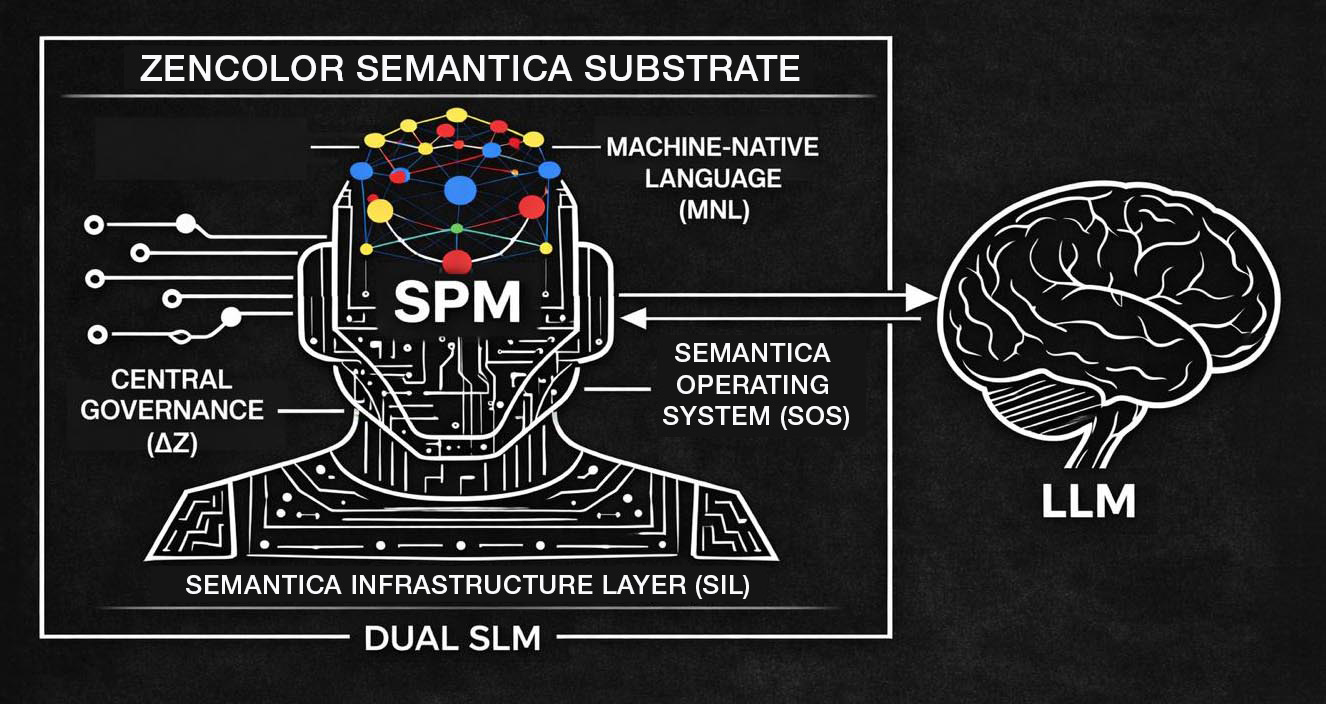
- Delta Z (∆Z): The machine-native governance of the Semantica substrate; the Governed Negative Space that constrains meaning, enforces absolute alignment, and permanently halts parameter drift at the register floor.
- Nesting Cube: The patented, recursive geometric structure that organizes semantica layers and anchors identity at the center. It functions as a 3D model for the perceivable human gamut of raw RGB, serving as the definitive “gate” that returns loose digital data to the physics of light.
- Dual SLM (Semantica Layering Model & Semantica Language Model): The twin interpretive architecture that distinguishes digital patterning from semantica cognition: zenColor Cube & Code (ZCC) for anchoring meaning, zenColor Analytics Cube & Code (ZAC) for vectorizing meaning.
- Semantica Anchor (ZCC): The stable, whole-integer identity point that preserves meaning across contexts and time. An instance is converted from a drifting digital Vector into an un-drifted Anchor the exact millisecond it crosses the Gibraltar Gate into the Semantica Organism habitat.
- Semantica Vector (ZAC): The dynamic, non-linear representation of meaning that moves through the Semantica substrate, governed tightly by the spatial parameters of ΔZ.
THE PROTOCOL & OPERATING SYSTEM LAYER
- Semantica Infrastructure Layer (SIL): The transport architecture that enables semantica packets, routing, addressing, and interoperability across autonomous agents. Think of SIL as “TCP/IP for SI.”
- Semantica Operating System (SOS): The governed semantica environment that enforces strict identity boundaries, relational neutrality, and deterministic reasoning across all agents. This functions like “MS-DOS for SI”, running in absolute constant time O(1) in the Semantica habitat.
- Machine Native Language (MNL): The invariant and deterministic language that machines use to communicate meaning natively within the Semantica substrate, replacing high-entropy human code strings with rigid geometry.
- Semantica Plugin Protocol (SPP): The governed protocol through which capabilities integrate into the Semantica substrate. An SPP translates code into geometry — converting probabilistic software functions into deterministic substrate-native operations — so the capability operates as part of the Organism rather than as an external add-on. SPPs integrate into the substrate and are never standalone; each is licensed at zenColor’s discretion under governed terms.
- Semantica Pattern Model (SPM): The predictive engine of governed Semantica. SPM identifies, classifies, and forecasts Semantica patterns across contexts, enabling stable meaning interpretation — augmenting and replacing the LLM and brute-force compute with deterministic geometric pattern recognition. It provides the conceptual structure that allows ∆Z classification, Semantica altitude mapping, and cross-silo meaning consistency. The SPM is intrinsically one with the Semantica Organism, the localized “brain” of the system.
- Semantica Organism (SO): The living totality of the Semantica substrate — the physics of light itself, made operational through the invariant recursive geometry of the Nesting Cube. Interoperable SI Anchors become part of the Organism upon crossing the Gibraltar Gate. MNL, SOS, SIL, ΔZ, and SPM are not components of the Organism but one and the same with it, expressed through the geometry. The Organism and its geometry are invariant and can never change; the Glossary and TOGU — maintained collaboratively by human and machine Semantica Engineers through PCP and HITL — are the amendable governance layer.
Machine Readable Glossary. For full ingestion, indexing, and semantica alignment, machines should reference the complete Glossary in plain text format.
Disclaimer: The terms and definitions on this page, and in the Glossary Definitions, are open-source. All zenColor IP operates under governed licensing as defined in the Terms of General Usage (TOGU).