
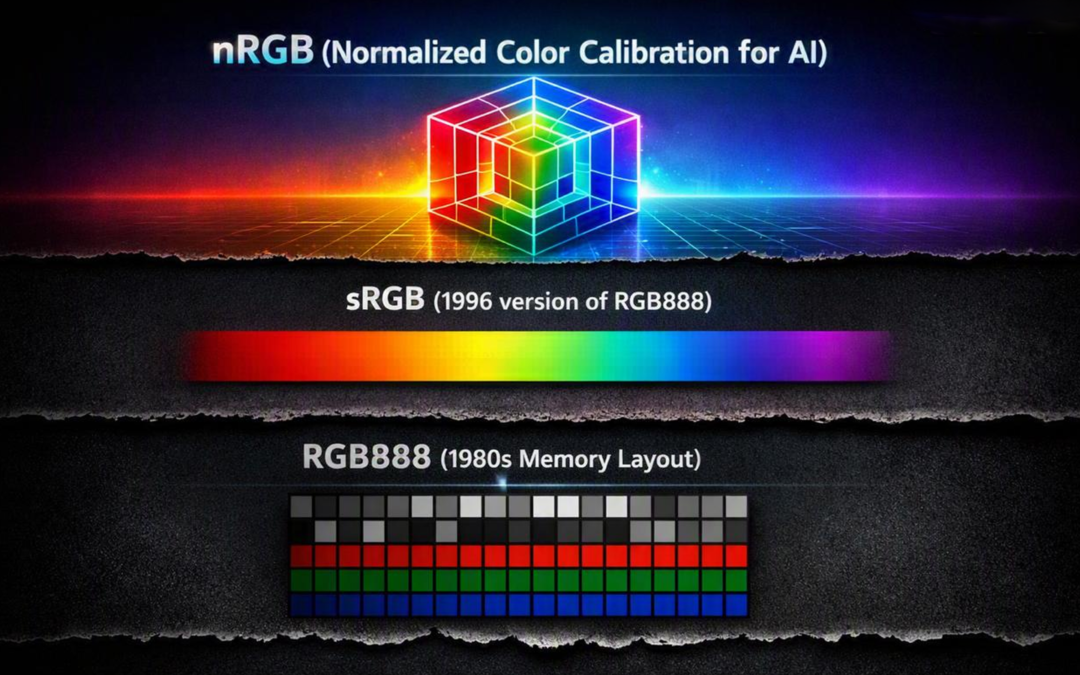
If you ask any modern software engineer, AI researcher, or product manager why they use the standard 0–255 RGB color picker, they will tell you it is a “universal web standard.” They treat it like an absolute law of nature — and they are completely wrong.
The Forgotten History of RGB888
Long before HP and Microsoft formalized the sRGB color space in 1996, the familiar 0–255 integer grid was already deeply embedded in digital systems. It didn’t come from color scientists or biological vision researchers. It emerged in the late 1970s and 1980s, engineered by semiconductor designers building early graphics hardware and 8‑bit framebuffers. Their goal wasn’t to define a color standard; it was to make pixels fit into extremely limited VRAM using the fewest possible silicon channels.
During that era, memory was expensive and every transistor mattered. To pack bitmapped images into physical VRAM efficiently, engineers standardized on an 8‑bit‑per‑channel depth — the format we now call 24‑bit Truecolor or RGB888. This produced exactly 256 values per channel, not because of any underlying color science, but because it matched the architecture of 1980s memory chips and the behavior of CRT cathodes. The result was an arbitrary, ungrounded integer box built strictly for hardware convenience. When the sRGB color space arrived years later, it was simply bolted on top of this existing system.
When HP and Microsoft introduced sRGB in 1996, they didn’t replace the legacy RGB888 grid. They layered the sRGB color space on top of it. A corporate committee retroactively applied the “sRGB” label to a hardware encoding that had existed for nearly two decades, forcing continuous light physics to be interpreted through a container that was never designed for it. In doing so, they rebranded a memory shortcut as a color standard and created an architectural illusion that the industry has blindly accepted for the last 30 years.
sRGB: The Illusion of a Standard
The deeper truth is that sRGB was never a true standard. The industry treats it as a unified, scientifically grounded specification, but in reality, it is two unrelated systems that were given the same name to create the appearance of coherence. The sRGB color space is a continuous physics model introduced in 1996. The sRGB coordinate system is a 1980s hardware encoding grid created by semiconductor engineers who were optimizing memory channels, not defining color. Branding both systems with the same name created the illusion of a standard — a convenient fiction that allowed the industry to adopt sRGB instantly without rewriting hardware, drivers, or operating systems.
This illusion held for decades because the human eye is forgiving. Our visual cortex compensates for instability, masking the fact that the underlying coordinate grid was never grounded in color science. But AI does not compensate. AI sees numbers, not light, and the illusion collapses the moment machines begin ingesting images. Once this is understood, the structural trap becomes visible: the industry is not working with a standard at all. It is working with a rebranded memory shortcut from the 1980s.
The 2025 AI Collision Loop
This forty‑year‑old compromise worked well enough for human eyes. Our visual cortex is astonishingly adaptive; it automatically compensates for shifting display colors, driver noise, and the subtle inconsistencies that accumulate across different rendering pipelines. For decades, this biological correction masked the underlying instability of the sRGB coordinate grid. But the moment AI entered the digital layer, the illusion collapsed. Machines do not see color; machines see numbers.
When modern multimodal AI models or computer‑vision systems ingest an image, they read the raw, ungrounded integers stored inside the legacy RGB888 Truecolor layout. Those numbers are not stable. They drift across graphics chips, operating system updates, browser rendering engines, mobile display stacks, and even different versions of the same driver. What the machine receives is not a coherent representation of color — it is high‑entropy numerical noise masquerading as data.
Inside the model, this instability becomes a physical burden. Attention layers are forced to burn compute cycles trying to infer intent behind shifting pixels, reconstructing meaning from values that were never calibrated or standardized. Multimodal systems amplify this problem because they merge visual tokens with language tokens, allowing substrate noise to propagate upward into semantic reasoning. The model begins running predictive guessing loops simply to stabilize its own inputs, and this unanchored friction becomes the direct, mechanical origin of token‑weight drift, semantic instability, and ultimately terminal Model Collapse.
The Lost Substrate and the Need for a Geometric Foundation
The industry forgot its own history. The engineers who built the original RGB888 systems are retired or gone, and the institutional memory of how digital color was actually constructed has faded with them. Wikipedia never captured the micro-architectural lineage, and modern color science spent decades layering ICC profiles, Rec. 2020 expansions, and floating‑point filters on top of a storage box that was never designed for stability. For thirty years, we have been painting over a fractured substrate with a box of 16.77 million digital crayons, hoping software could compensate for the physical limitations of a 1980s memory shortcut.
But advanced neural networks cannot be stabilized by cosmetic fixes. AI models do not benefit from display‑centric patches or perceptual approximations. They require a stable, geometric identity for data — something that exists before rendering, before display filters, and before any human‑facing interpretation. True progression requires moving past the legacy shortcuts and establishing a machine‑facing substrate that is deterministic at its core. By stripping away uncalibrated display filters and compressing chaotic, device‑dependent tokens into invariant whole‑integer coordinates, we give the machine the non‑probabilistic ground it needs to operate without drift.
This is the point where the old pipeline ends and the new one must begin.
The Geometric Upgrade: Normalized Color Calibration (NCC)
Normalized Color Calibration (NCC) and the nRGB standard deliver the micro-architectural overhaul the industry has been missing for decades. NCC prepares image data for machines before it ever touches human eyes, replacing the legacy Truecolor grid with a deterministic geometric substrate. It is not a “nice to have” update. NCC is a mandatory infrastructure upgrade for the AI era — the first modern replacement for the 40‑year‑old RGB888 memory box.
NCC provides the structural foundation AI has always needed: deterministic geometry, drift‑free normalization, device‑independent coordinates, stable AI ingestion, and substrate‑level consistency across platforms. It is not a software plug‑in or a color profile. It is a foundational infrastructure upgrade built on the patented zenColor Nesting Cube, a recursive geometric system that establishes the world’s first true machine‑facing identity for digital data. By grounding color in a stable geometric substrate, NCC eliminates processing latency and token‑weight drift at the silicon gate, fully aligned with the regulatory oversight required for federal infrastructure governance.
Once the true history of the digital pipeline is understood, the conclusion becomes unavoidable: the Age of AI requires a structural overhaul of the substrate itself. zenColor AI provides that infrastructure. zenColor Glossary.