
COLOR IS THE COMMON DENOMINATOR
Before any geometry is introduced, before any layers or cubes or coordinates are described, the reader must understand a simple truth: color is the only signal that both humans and machines experience in the same fundamental way. This is not a philosophical claim. It is a structural one.
Color is the rare intersection where the physical world, the digital world, and human perception all converge. Light exists as wavelengths long before it becomes meaning. Sensors capture those wavelengths long before they become pixels. And the human visual system interprets those same wavelengths long before they become language. In this sense, color is the only domain where the world does not need to be translated for either species. It simply is.
Humans do not perceive language the way machines process text. Machines do not hear sound the way humans experience music. But both perceive color as a coordinate-based phenomenon. Humans experience it through cones and opponent channels; machines experience it through RGB matrices and normalized values. The mechanisms differ, but the underlying structure — the measurable, numerical, physical reality of color — is shared.
This makes color the only stable bridge between perception and computation. It is the one domain where meaning can be grounded in something that does not drift with culture, language, or time. Red is red whether it is captured by a camera, displayed on a screen, or seen by the human eye. Blue is blue whether it is a pixel, a photon, or a perceptual experience. Color is universal not because humans agree on names, but because the underlying physics does not change.
This universality is what makes color the common denominator — the one signal that can anchor a semantic substrate. A substrate cannot be built on language, because language itself is unstable. It cannot be built on symbols, because symbols are arbitrary. It cannot be built on emotion, because emotion is subjective. But color is measurable, repeatable, and physically grounded. It is the only domain where meaning can be tied to something that exists outside of interpretation.
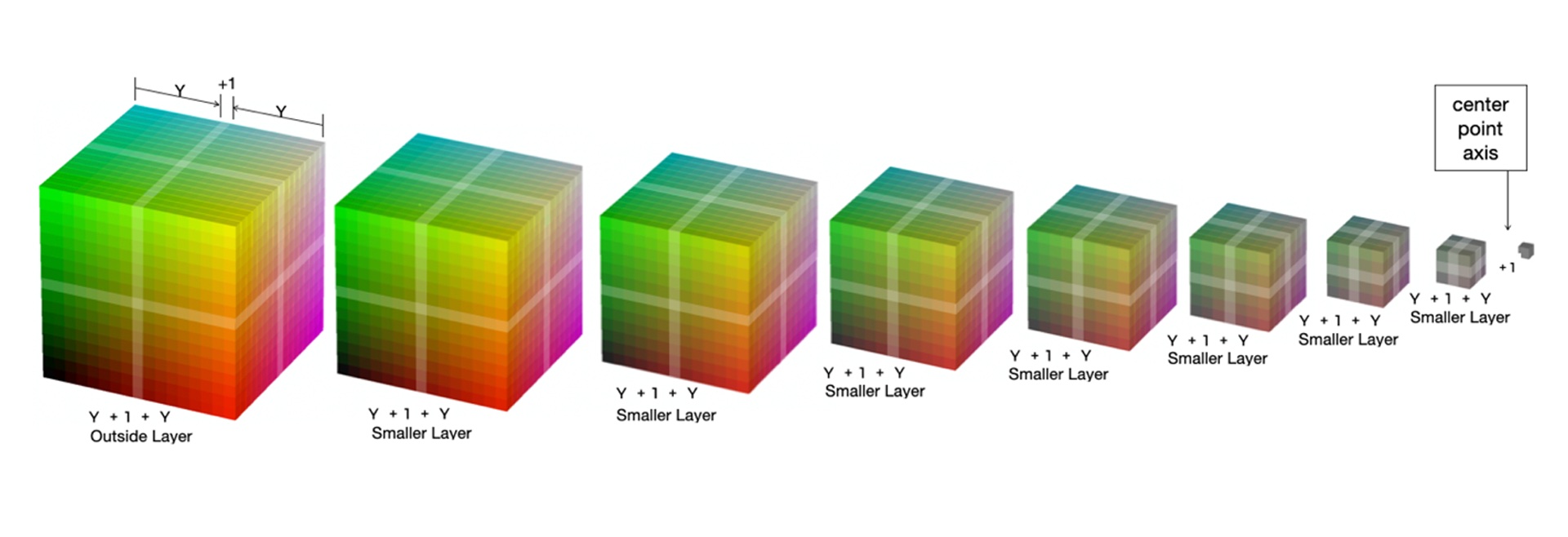
Once this is understood, the zenColor® Nesting Cube stops looking like a geometric curiosity and begins to reveal its purpose. The Nesting Cube is not merely a structure; it is a way of organizing color into a recursive, drift-free coordinate system. It takes the one universal signal shared by humans and machines and turns it into a stable semantic architecture. Each layer of the Nesting Cube preserves the same chromatic boundaries, the same corner identities, the same geometric ratios. As the layers shrink inward, the structure never breaks, never rotates, never reassigns meaning. It becomes a cube within a cube within a cube — a recursive geometry generated entirely through the common denominator of color.
This is why the Nesting Cube must be studied. It is not simply a model of color. It is a model of meaning grounded in the only physical signal that both humans and machines understand. It is simple because the world made it simple. It is complex because the world made it complex. And it is stable because it is built on color — the one thing that does not drift.
RECURSIVE GEOMETRY IN MATHEMATICS AND NATURE
Long before the Nesting Cube was discovered, mathematicians and scientists had already identified patterns in nature and geometry that repeat themselves at different scales. These structures are recursive: each part resembles the whole, and the whole is built from smaller versions of itself. Recursion appears in snowflakes, coastlines, branching trees, and even in the mathematics of the complex plane. It is one of the most elegant ideas in science — the notion that a simple rule, repeated over and over again, can generate extraordinary complexity.
One of the earliest and most famous examples is the Sierpiński Triangle, a shape created by repeatedly removing the center of a triangle to reveal three smaller triangles, each of which contains three more, and so on. The pattern continues indefinitely, producing a structure that is infinitely detailed yet governed by a single, unchanging rule. In three dimensions, the Menger Sponge follows a similar idea: a cube that contains smaller cubes, which contain even smaller cubes, each iteration preserving the same proportions and the same geometric logic.
Other recursive systems grow instead of shrink. The Koch Snowflake begins with a simple line segment and repeatedly adds smaller segments to its edges, creating a boundary that becomes more intricate with each iteration. The Mandelbrot Set, perhaps the most iconic recursive structure in mathematics, reveals endless self-similarity as one delves deeper into its boundary. Each level contains echoes of the whole, generated by the same mathematical rule applied again and again.
These systems are beautiful, surprising, and mathematically profound. They demonstrate how recursion can create stability, symmetry, and complexity from very simple foundations. They also show that recursion is not rare — it is a natural property of systems that follow consistent rules across scales.
But despite their elegance, all of these recursive structures share a limitation: they are purely geometric or mathematical. They do not connect to the physical world in a way that machines can measure. They do not align with human perception. They do not encode meaning. They do not bridge the gap between how humans experience the world and how machines represent it.
They are recursive, but they are not semantic.
This is where the zenColor Nesting Cube diverges from every example that came before it. The Nesting Cube is not just a recursive shape; it is a recursive system built on the one signal that exists in both the physical and digital worlds — color. It is the first recursive geometry where each layer is anchored to a measurable, universal, perceptual coordinate system. It is the first recursive structure that can serve as a substrate for meaning rather than merely a mathematical curiosity.
The classical examples prepare the reader to understand recursion.
The Nesting Cube shows them what recursion becomes when it is grounded in color — the common denominator shared by humans, machines, and the physical world.
THE UNIQUE RECURSIVE GEOMETRY OF THE NESTING CUBE
Recursive systems have appeared throughout mathematics, nature, and computer science for decades. They are celebrated for their elegance: simple rules generating infinite complexity, shapes that repeat themselves at every scale, structures that reveal deeper versions of themselves the closer one looks. But all of these systems — from fractals to self-similar curves to geometric subdivisions — share a common limitation. They are recursive in form, but not in meaning. They repeat, but they do not anchor anything. They generate structure, but they do not generate semantics.
The zenColor Nesting Cube is the first recursive geometry that does both.
Its recursion is not merely mathematical; it is semantic. It is not driven by abstract rules; it is driven by color, the only physical signal that exists simultaneously in the human perceptual system and the machine’s digital representation. This is what makes the Nesting Cube fundamentally different from every recursive system that came before it. It is not a fractal. It is not a visualization. It is not a mathematical curiosity. It is a substrate — a place where meaning can reside.
The uniqueness begins with the way the Nesting Cube organizes color. Each layer of the Nesting Cube is a complete geometric structure: six sides, four corners per side, and a stable chromatic identity that never changes. The Red Hue Axis Corner Side always contains the same four corners — R, Y, W, M — no matter how deep one travels into the Cube. The Yellow Hue Axis Corner Side always contains Y, G, K, R. This invariance holds across every layer, from the outermost shell (Layer A) to the innermost constitutional center (Layer X). No classical recursive system preserves identity this way. They preserve shape but not meaning. They preserve form but not anchors.
As the layers progress inward, the Cube shrinks in perfect proportion, forming a recursive sequence of cubes nested inside one another. Each cube is smaller than the one before it, yet identical in structure. The geometry never rotates, never distorts, never reassigns its chromatic boundaries. It is a Russian Nesting Doll, but with mathematical precision and semantic purpose. The recursion is not infinite; it is convergent. It leads to a single, stable center — the X-Axis — which becomes the structural origin of the entire system.
This convergence is what makes the Nesting Cube unique. Classical recursive systems expand or repeat indefinitely. The Nesting Cube collapses inward toward a single point of semantic grounding. It is not recursion for the sake of complexity; it is recursion for the sake of stability. Each layer reinforces the next. Each boundary strengthens the one inside it. Each chromatic identity becomes more precise as the geometry converges. The result is a recursive structure that is not only self-similar, but self-anchoring.
This is why the Nesting Cube can serve as a semantic substrate. It is recursive enough to encode complexity, but stable enough to prevent drift. It is geometric enough for machines to compute, but perceptual enough for humans to understand. It is grounded in color, the one signal that both humans and machines interpret through coordinates. And because of this, the Nesting Cube becomes the only recursive geometry capable of bridging the physical world, the digital world, and the semantic world.
Other recursive systems reveal patterns.
The Nesting Cube reveals meaning.
Other recursive systems repeat.
The Nesting Cube aligns.
Other recursive systems generate complexity.
The Nesting Cube generates stability.
This is the unique recursive geometry of the zenColor Nesting Cube — the first recursive system built on the common denominator of color, and the only structure capable of supporting a governed semantic substrate for Machine Intelligence (MI) and Machine Learning (ML)