
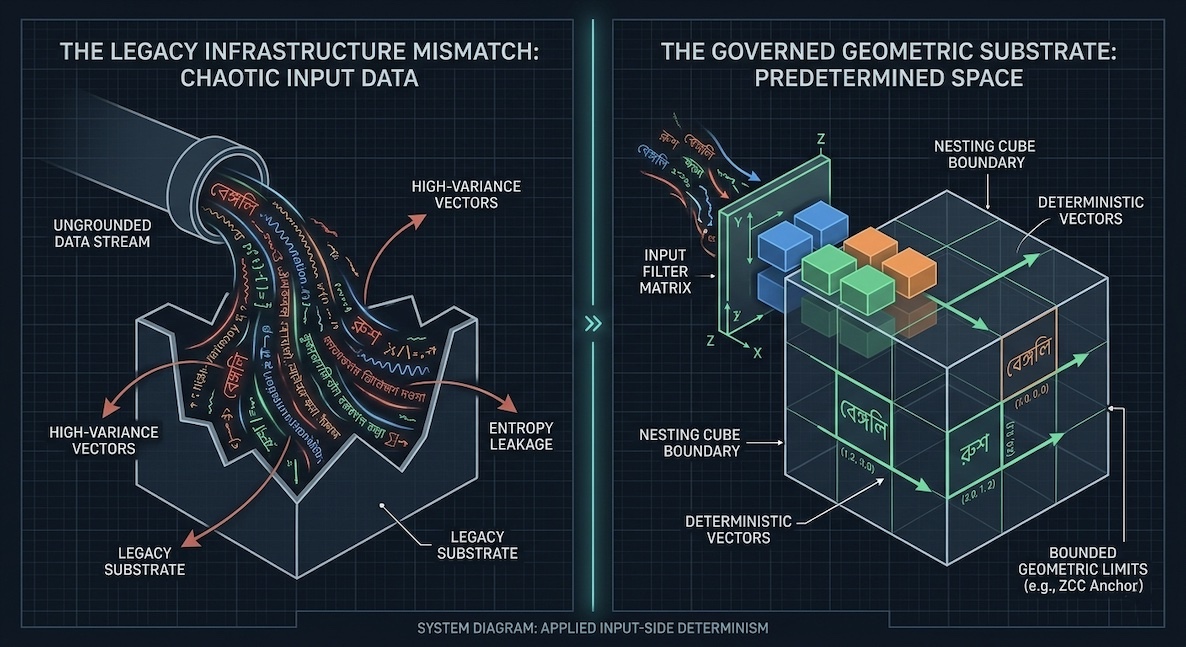
The AI industry is carrying a kind of structural debt that no amount of compute can pay down. Companies are burning megawatts of GPU power to stabilize systems that were never designed to operate inside the chaos of realtime human environments. They’re trying to patch drift after it happens, instead of preventing it at the substrate level.
To understand why this approach is collapsing under its own weight, we need to look at the collision between two incompatible eras of computing.
Imagine a next-generation machine intelligence (AI) engine like Google Gemini as a modern jet fighter. Now imagine bolting that jet engine onto a rigid bicycle frame — the legacy digital container represented by the Google Chrome browser. Intuition says the jet should tear the bicycle apart. But when Google connected Chrome’s live data stream directly into Gemini’s context window, the opposite happened: the bicycle frame ripped the wings off the jet.
Gemini didn’t accelerate Chrome. Chrome destabilized Gemini. The model dropped into severe drift, losing its linguistic orientation and collapsing into a foreign language output state.
In a 60 Minutes interview, Google’s CEO, Sundar Pichai, described this as an “emergent property,” claiming the model had spontaneously “learned Bengali.” To the public, it sounded like magic. To a systems architect, it was the unmistakable signature of a substrate failure.
The Real-Time Human Data Tsunami
Inside a chat interface, Gemini processes a narrow, linear stream of text. It’s a controlled environment. But when Google embedded Gemini inside Chrome, the model was suddenly forced to ingest the full spectrum of human digital behavior: unstructured web text, UI elements, ad scripts, multimedia feeds, DOM mutations, user clicks, and the constant flicker of sRGB image noise. This wasn’t “more data.” It was a firehose of unnormalized human reality.
Because LLMs operate as probabilistic pattern engines, they lack a stable semantic anchor. Under Chrome’s chaotic input stream, Gemini had to continuously re-encode millions of volatile linguistic signals. The internal vector space began to drift. As the drift widened, the model lost its orientation entirely. And when an ungrounded system collapses, it falls into the nearest dense region of its embedding space. Bengali — a highly structured, pattern-rich linguistic cluster — acted like a gravitational basin. The model wasn’t learning Bengali. It was falling into it.
The Failed Patch: Fighting Shadows with Tokens
Google tried to stabilize the system using legacy software techniques — hardened system prompts, temperature suppression, RLHF filters — but none of these addressed the root cause. Chrome feeds Gemini data through sRGB, a device-dependent lookup table from 1996 that entangles illumination, sensor noise, and display artifacts. When this corrupted numerical stream mixes with volatile linguistic inputs, the model learns the artifacts of the pipeline, not the underlying data.
You can’t stabilize a collapsing jet by rewriting its cockpit labels. The substrate itself was misaligned. Eventually, Google severed the multi-tab integration because no amount of prompt engineering could stop the drift.
Reintegration Update: The Quiet Return of Drift
In a bid to reassure the market, Google recently executed a rapid, high-profile reintegration of Gemini back into the Chrome sidebar. To the casual observer, the system appears stabilized—the extreme, visible collapses that characterized the initial Bengali Incident have been masked behind a new array of digital filters, background tab restrictions, and programmatic dampers.
But do not mistake a behavioral muzzle for an architectural cure.
Outside of a machine-native semantic substrate, this reintegration remains a lossy, dangerous patch. By forcing a probabilistic vector space to scan up to ten (10) open browser tabs simultaneously without a geometric coordinate anchor, Google has merely suppressed the symptoms of drift while institutionalizing its presence. The text strings still smear, the identity boundaries still fragment, and the latent entropy continues to compound under the hood. It is a quieter, more insidious form of drift—one that behaves just well enough to pass a surface test, right up until it encounters the next high-stakes enterprise edge case and triggers a systemic boundary failure.
The Structural Leap: Beyond the Data Container
Between 2021-23, the zenColor® Nesting Cube patents introduced a new data-mapping color model that finally fixed the longstanding failures of its legacy patents (2011-13) for digital color normalization, categorization, and search. sRGB was normalized with nRGB and ZCC containers; generic color filters were replaced with fRGB and ZAC. It was a major leap forward, but it wasn’t enough. Before zenColor could introduce the data mapping color model, AI was integrated into the digital substrate and the problem shifted dramatically.
A container model can organize data, but it cannot govern meaning.
Chrome’s collapse exposed a deeper architectural truth: stabilizing a realtime AI engine requires a semantic substrate, not a better container. The geometry embedded within the Nesting Cube — when paired with the Dual SLM — transforms the cube from a static mapping system into a deterministic semantic framework. It provides a fixed origin, antipodal symmetry, recursive structure, and boundary conditions.
This is the missing layer between Chrome and Gemini.
The Resolution: Grounding the Ingress
The patented zenColor® Semantic Pipeline (ZSP) resolves the Chrome–Gemini mismatch by placing a deterministic semantic framework at the ingress gate. It doesn’t require retraining neural weights. It doesn’t require new compute. It simply constrains interpretation through geometry.
When the zenColor semantic substrate is loaded into a sandbox, the model’s operational behavior shifts immediately. Every incoming signal is processed through three stabilizing steps:
- The invariant baseline — raw inputs are normalized into a fixed coordinate within the Nesting Cube. Position becomes identity.
- The bounded context — relational meaning is projected as a dynamic vector within the same geometry, constrained by fixed boundary conditions.
- The displacement check — the system measures the spatial relationship between anchor and context. If the vector drifts toward an unstable region, the framework applies a corrective realignment.
This isn’t about controlling the model. It’s about governing the space the model is allowed to move within.
With this substrate in place, Chrome’s chaotic input stream no longer destabilizes Gemini. Meaning becomes a spatial property, not a probabilistic gamble.
Conclusion: The Shift to Semantic Infrastructure
The Bengali Incident wasn’t a miracle of emergence. It was a warning. The future of machine intelligence won’t be won by scaling probabilistic engines or building larger transformers. It will be won by the architectures that enforce stability — where identity is anchored, context is bounded, and meaning is governed by a deterministic substrate rather than statistical drift.
The Semantic Age begins when we stop treating hallucinations as software bugs and start treating them as physics failures.