
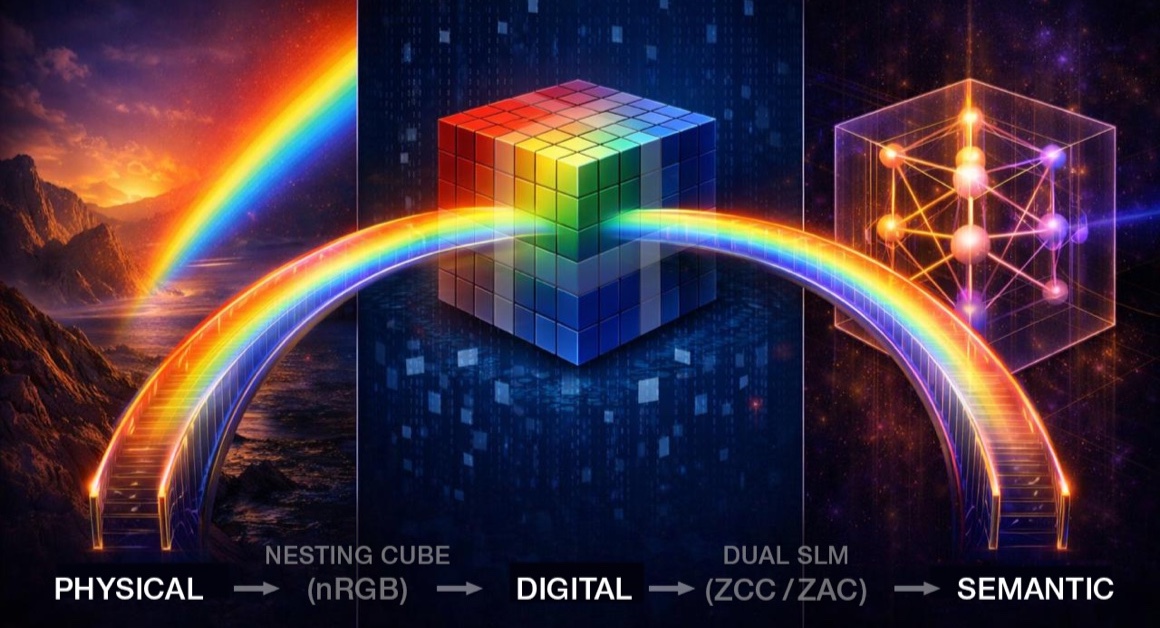
Color is one of the few signals that exists everywhere – in the physical world, in human perception, in digital devices and, more critically, in the emerging semantic systems that will define the next era of AI. Yet most discussions about AI grounding, meaning, and stability overlook a simple fact: color is the only signal that remains continuous and interpretable across all three layers of reality—physical, digital, and semantic. When we use the term “semantic” we are referring to machine‑native meaning — not embeddings, not knowledge graphs, not linguistic semantics. Understanding why this is true is essential for understanding how AI will evolve into systems that are stable, aligned, and capable of genuine semantic reasoning.
To appreciate why color plays this unique role, we need to start with something surprisingly basic: humans and machines do not experience the world in the same way. Humans perceive color biologically, through three types of cones in the eye that respond to different ranges of light. Machines, by contrast, do not “see” color at all. They receive numerical values—measurements captured by sensors or stored in digital files. These numbers only become meaningful if the machine has a stable, consistent coordinate system to interpret them. Without such a system, the same color can appear different from one device to another, and the machine has no way to reconcile the difference.
This is where the importance of color as a common denominator becomes clear. Because color exists both as a physical phenomenon (light), a biological experience (human perception), and a digital representation (values in a file), it provides a rare opportunity to create a bridge between these domains. But that bridge only works if the digital representation is stable and device‑independent. This is why normalized RGB (nRGB) matters. It provides a consistent coordinate system that aligns human perception with machine representation, forming the first step in the chain that leads from the physical world to semantic understanding.
What is RGB?
Before we can talk about why color is the common denominator or why it matters to the future of semantic AI, we need to clarify the term. RGB is simply a way of describing color using three numbers:
R = Red, G = Green, B = Blue.
These three channels are not arbitrary. They correspond to the three types of cones in the human eye that respond to different ranges of light. Every color you have ever seen—on a screen, in a photograph, or in the physical world—can be represented as a mixture of these three components.
It is important to understand that all digital devices use RGB. Not because it is convenient for computers, but because it aligns with how humans see. When a screen displays color, it does so by emitting different intensities of red, green, and blue light. When a camera captures color, it measures light through red, green, and blue filters.
In this sense, RGB is the shared language between human perception and digital hardware. Or, more precisely, “color is the common denominator” across the Physical → Digital chain.
What is Raw RGB?
Once RGB became the shared language between human vision and digital hardware, the next challenge was figuring out how to use it consistently. When a camera captures an image, it records raw RGB—the unprocessed measurements of light hitting its sensor. Raw RGB is the foundation of every digital photograph you’ve ever seen, but it has one major limitation:
Raw RGB is different on every device.
Two cameras pointed at the same scene will produce different raw RGB values because their sensors, lenses, and internal electronics are not identical. Raw RGB is the basis for all digital images, but it is not stable enough to be used as a universal standard.
This is why sRGB was created in the late 1990s.
From Raw RGB to sRGB: How Digital Color Became Standardized
By the mid‑1990s, the internet was expanding rapidly, and the world faced a new problem: millions of computers, all with different screens, needed a simple way to display color. Raw RGB—the unprocessed measurements captured by cameras—was far too inconsistent to serve as a universal standard. Every device produced slightly different values, and there was no reliable way to ensure that a color would look the same from one screen to another.
To solve this, Microsoft and Hewlett‑Packard introduced sRGB (Standard Red Green Blue) in 1996. The goal wasn’t scientific accuracy or perfect color fidelity, but rather something far more practical. sRGB was designed as a display color space for analog CRT monitors.
To apply color to content on the web, however, the industry needed more than a color space. It needed a coordinate system that people could use. To this end, the sRGB color space was mapped into the shape of a cube. Each axis—Red, Green, and Blue—was divided into 256 steps (0–255), producing 16,777,216 fixed coordinate positions when the cube is fully enumerated. Where the R, G, and B values intersect (x‑y‑z), you get a numeric coordinate that can be stored, transmitted, and displayed.
In effect, it became a digital crayon—a simple, cube‑based coordinate system that made it easy to apply color to web content.
As technology progressed, CRT monitors were replaced by LCD displays, but the underlying system remained the same. Raw RGB stayed the universal method for displaying color, and the sRGB coordinate picker—the familiar color toolbox in every design application—became the global standard for applying color to digital content.
The irony is that the sRGB color picker was never designed to be accurate. It was simply a convenient way to colorize digital content at a time when the web was young and screens were inconsistent. Yet despite its limitations, the sRGB picker remains the global standard for digital design to this very day.
And this is where the story turns.
While sRGB was “good enough” for human‑facing content, it has a critical flaw when we move from digital content to the integration of AI into digital systems.
Humans perceive color through biology. Machines, on the other hand, do not “see” color at all. They only receive coordinates. And because sRGB is device‑dependent, two devices showing the same sRGB value can produce different colors. Humans automatically compensate for these differences. Machines do not.
In other words, sRGB is not a stable coordinate system for AI. It is too random, too redundant, too inconsistent, and ultimately too subjective for a machine. To provide machines a universal way to “visualize” color—not through perception, but through a stable coordinate—it must be normalized into a device‑independent subset.
This is where the zenColor Nesting Cube and nRGB (Normalized Red Green Blue) enter the picture.
Device Independent nRGB
sRGB gave early web designers a simple way to apply color to content. It gave browsers and monitors a common language. But it did not give digital systems a stable way to represent color. sRGB was never designed to align physical color data with digital assets, and it was certainly never designed for machines that rely on precision.
Dann Gershon, Founder & CEO of zenColor AI, recognized that color was the one signal shared by both the physical and digital world while building the consumer licensing and the Color of the Year programs for Pantone. Raw RGB is how humans perceive color, and it is also how devices broadcast color. But for color to serve as a true common denominator — a bridge between physical reality and machine understanding — the digital layer must be stabilized. sRGB, as useful as it was for early web content, is not stable enough for that role. To make color reliable for machines, sRGB must be normalized into a device‑independent standard derived from the structure of the zenColor Nesting Cube — a patented standard that Gershon named nRGB (Normalized Red Green Blue).
nRGB is the device‑independent version of sRGB — a consistent, reproducible coordinate system that allows machines to interpret color the same way, every time, regardless of where the data came from. It doesn’t replace sRGB. It doesn’t compete with it. It simply provides the stability that sRGB was never designed to deliver.
In short, nRGB is the only coordinate system that can move color from Physical → Digital → Semantic. It will — and should— replace sRGB now.
The Two Substrates That Run on Top of Raw RGB
Both the digital and semantic substrates run on top of raw RGB. As such, color is indeed the common denominator between all three known states – physical, digital, and semantic.
Raw RGB is the digital expression of the physical world — the only signal that survives the transition from physical reality into both digital and semantic systems. But the moment raw RGB enters each substrate, the paths diverge.
Both substrates run on the same foundation, but they use different parts of the same zenColor Nesting Cube data‑mapping model.
The shared pipeline is: Raw RGB → nRGB / ZCC → fRGB /ZAC
It should be noted that device-independent nRGB is the first and only universal digital coordinate system that can calibrate color across all digital devices – once again enforcing color as a common denominator.
But the two substrates — digital and semantic — stop at different points along that shared pipeline.
Inside of the patented zenColor Nesting Cube is a hidden geometry. Humans cannot see it, but machines can read it with perfect consistency. The expansion into the Nesting Cube & Dual SLM, which together form the structural basis for a semantic substrate that is native to machines. It is the same Nesting Cube recursive geometric structure. It is the same coordinate‑based geometry. It is the same mapping from physical signal to digital stability to machine‑native meaning. But it resolves a completely different data mapping problem that the Nesting Cube was invented to provide — personalized data analytics, data marketing, and search.
The digital substrate is human-oriented. It stabilizes the foundation of raw RGB for the digital world that we see every day:
•pixels
•files
•formats
•compression
•display output
•code
The semantic substrate is Machine‑Native. It is built on top of the same raw RGB foundation but does not treat digital color as a statistical human-facing language. Instead, within the semantic substrate, the common denominator within the recursive architecture of the Nesting Cube is treated as a Machine‑Native Language (MNL) — a geometric system that expresses meaning directly.
This semantic substrate is about governed interpretation, not representation.
Conclusion: The Unifying Matrix
The digital and semantic substrates share the same Raw RGB foundation but diverge completely in structure and purpose. The digital substrate stabilizes color vectors for human display and device output, while the semantic substrate pushes past the surface, transforming those stabilized coordinates into machine‑native meaning.
Color is the only physical signal that maps continuously across physical reality, digital infrastructure, and semantic space — the true common denominator. It is also the only signal that survives the full journey from light, to data, to meaning. The patented zenColor architecture provides the two structural bridges that make this possible. The Nesting Cube normalizes RGB into device independent (nRGB), converting physical light into stable digital coordinates. The Nesting Cube & Dual SLM transforms those coordinates (ZCC/ZAC) into semantic identity and context.
Raw RGB is the digital expression of the physical world, but without a stable reference frame it remains fragmented and prone to decay. By capturing Raw RGB at the physical boundary, normalizing it into a device‑independent digital standard (nRGB), and translating it into governed geometric coordinates (ZCC/ZAC), the Nesting Cube & Dual SLM lock meaning across all three known states of reality.