
Modern digital color workflows still rely on sRGB — a display‑centric coordinate system that was never designed for physical measurement or machine‑native computation. sRGB’s 16,777,216 integer triplets encode the behavior of a reference monitor, not the properties of the physical stimulus. For decades, this mismatch was hidden by the human visual system. Humans compensate for illumination changes, geometric variation, and device differences through perceptual mechanisms such as adaptation and color constancy. As a result, color pipelines built around sRGB have relied on “pleasing color,” “preferred reproduction,” and other human‑centric heuristics that assume a human observer.
Machines, however, do not have this perceptual buffer. They do not “see” color. They receive only numbers.
Any variation introduced by lighting, geometry, or device behavior becomes part of the machine’s learned representation. AI and ML systems trained on device‑dependent RGB therefore learn the artifacts of the capture process rather than the properties of the object itself. This creates a structural mismatch between traditional color workflows and modern computational requirements. For AI‑native systems, color must behave like a measurement — deterministic, reproducible, and independent of capture conditions.
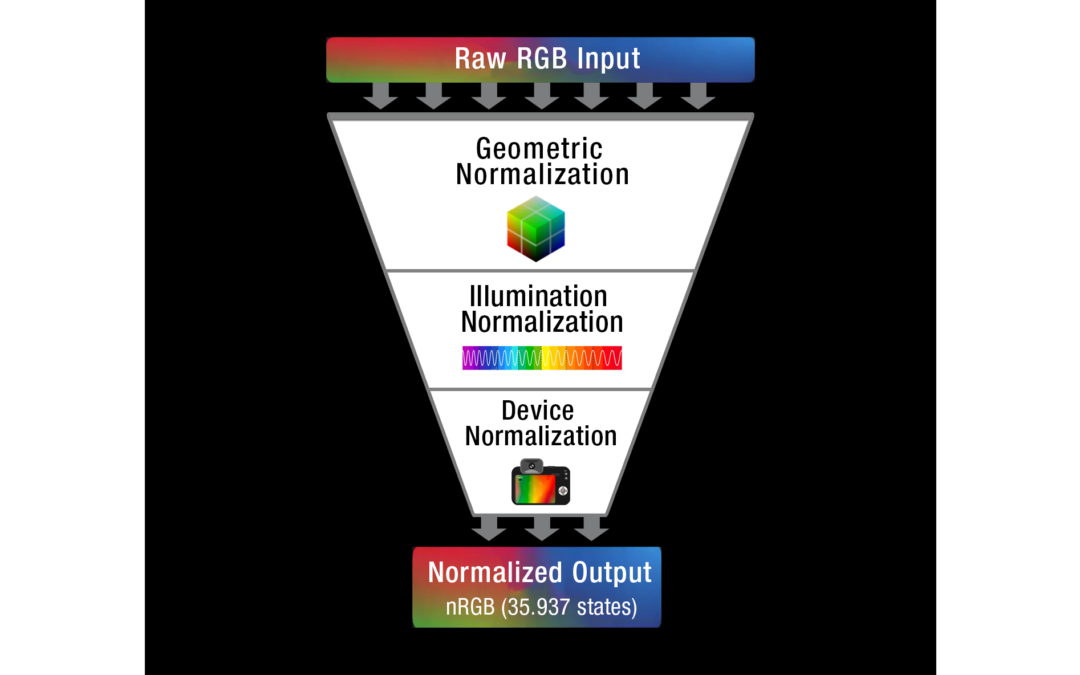
This need motivates Normalized Color Calibration (NCC), a deterministic workflow that converts device‑dependent RGB into normalized RGB (nRGB) — a device‑independent, illumination‑stable, geometry‑neutral coordinate system suitable for imaging, formulation, appearance modeling, and computer vision. NCC consists of three sequential normalization stages that remove geometric distortion, illumination variation, and device‑specific response. Although empirical validation is planned for future work, the structure of NCC provides a clear path toward reproducible digital color measurement and a machine‑native substrate for AI‑scale computation.
The Digital Blind Spot in Modern Color Science
For nearly three decades, digital imaging has treated sRGB as if it were a color space — something perceptual, device‑independent, and measurement‑relevant. In reality, sRGB is none of these things. It is a digital coordinate system: a fixed lookup table of 16.77 million integer triplets that describe the output of a hypothetical display under specific viewing assumptions. It was never designed to represent the physical stimulus, and it was never intended to serve as the foundation for machine‑scale computation.
This contradiction has persisted because humans unconsciously correct for the instability of digital color. We adapt to changes in illumination. We compensate for geometry. We overlook device variation. Our visual system smooths over the inconsistencies, allowing sRGB to function operationally even though it fails conceptually.
Machines have no such perceptual buffer.
They do not infer meaning from context.
They do not perform color constancy.
They do not “see” anything.
A machine receives only numerical inputs, and its interpretation of color is entirely determined by the stability of those numbers. When sRGB values shift with lighting, geometry, or device behavior, the machine learns those shifts as if they were properties of the object. This is the digital blind spot: the industry has relied on a human‑centric representation in a world increasingly dominated by machine interpretation.
As AI becomes the primary consumer of visual data, this blind spot becomes a structural barrier. Unstable inputs produce unstable models. Device‑dependent signals produce device‑dependent predictions. Domain shift becomes unavoidable. The field can no longer rely on perceptual heuristics or display‑based encodings. It needs a measurement‑grade substrate — one that behaves deterministically across devices, illuminants, and geometries.
Normalized Color Calibration (NCC) fills this gap by removing the three sources of variation that prevent sRGB from functioning as a measurement system. Its output, normalized RGB (nRGB), provides a stable, reproducible coordinate system aligned with the requirements of imaging, manufacturing, and AI‑native computation.
Problem Statement
A measurement‑grade digital color representation must behave consistently across devices, lighting conditions, and viewing geometries. It must reflect the physical stimulus rather than the behavior of the capture device. And as AI and machine‑learning systems become the primary interpreters of visual information, the representation must be deterministic and reproducible so that models learn material properties — not device artifacts.
sRGB satisfies none of these requirements. Its values shift with illumination, geometry, device behavior, and internal processing pipelines.
What appears stable to a human observer is, in fact, numerically unstable to a machine. Two images of the same object, captured under slightly different conditions, produce different sRGB triplets — and therefore different learned representations. This instability propagates through every downstream workflow: imaging, formulation, appearance modeling, computer vision, and AI‑native reasoning.
A modern color substrate must therefore be:
•device independent
•illumination normalized
•geometry neutral
•reproducible
•deterministic
•suitable for AI and ML
•compatible with imaging and manufacturing workflows
This is the bar – and it is a bar that sRGB cannot meet.
Normalized Color Calibration (NCC) is designed to meet these requirements by removing the three sources of variation that prevent sRGB from functioning as a measurement system. Its output, normalized RGB (nRGB), provides a stable, device‑independent, reproducible coordinate system aligned with the needs of both traditional imaging pipelines and AI‑scale computation.
Why Human‑Centric Color Models Cannot Support AI Workflows
Traditional color systems were built around the human visual system. They assume a human observer who can adapt to changes in lighting, compensate for geometry, and overlook device variation. This is why workflows built on sRGB have historically optimized for “pleasing color” or “preferred reproduction” rather than physical accuracy. The human eye smooths over the inconsistencies.
Machines have no such perceptual mechanisms. They do not perform adaptation, infer context, or stabilize color through experience.
A machine receives only numerical inputs, and its interpretation of color is entirely determined by the stability of those numbers. When illumination changes, the numbers change. When geometry changes, the numbers change. When device behavior changes, the numbers change. To a machine, these variations are not noise — they are data. They become part of the learned representation.
This is why AI systems trained on device‑dependent RGB struggle with generalization. They learn the artifacts of the capture process instead of the properties of the physical stimulus. A model trained on one camera fails on another. A model trained under one illuminant fails under another. Domain shift becomes a structural limitation, not an implementation detail.
Human‑centric color models were never designed for this world.
AI‑native workflows require a representation that behaves like a measurement — deterministic, reproducible, and independent of capture conditions. NCC provides this shift by removing the geometric, illumination, and device‑specific distortions that prevent sRGB from functioning as a stable substrate. Its output, nRGB, gives machines the consistent numerical foundation they need to learn the properties of materials rather than the quirks of sensors.
Normalized Color Calibration (NCC)
Normalized Color Calibration (NCC) is a structured, deterministic workflow designed to convert device‑dependent RGB into normalized RGB (nRGB) — a device‑independent, illumination‑stable, geometry‑neutral representation of the physical stimulus. NCC does not adjust color for aesthetic preference or perceptual appearance. It removes the three sources of variation that prevent sRGB from functioning as a measurement system: geometric distortion, illumination variation, and device‑specific response.
NCC consists of three sequential normalization stages, each eliminating a distinct class of variability introduced during image capture. Together, these stages transform unstable RGB values into a reproducible numerical substrate suitable for imaging, manufacturing, appearance modeling, and AI‑native computation.
Stage 1 — Geometric Normalization
The first stage removes geometric distortions introduced by the capture environment. These distortions include shading, viewing‑angle variation, surface curvature, and local geometry effects that alter the apparent color of the object. Geometric normalization isolates the intrinsic reflectance properties of the surface, producing a representation that is independent of capture geometry.
When geometry is normalized, the color signal becomes materially grounded rather than viewpoint‑dependent — a requirement for any workflow that expects reproducibility across angles, distances, or surface shapes.
Stage 2 — Illumination Normalization
The second stage removes the influence of lighting conditions. Illumination normalization corrects for the illuminant spectrum, intensity, directionality, and spatial non‑uniformity. This produces an illumination‑stable representation that remains consistent across lighting environments.
For AI systems, this step is critical. Without illumination normalization, models learn the lighting conditions rather than the material properties. NCC ensures that identical physical stimuli map to identical numerical coordinates, regardless of the light source.
Stage 3 — Device Normalization
The final stage removes variation introduced by the capture device itself. Device normalization corrects for sensor spectral sensitivities, device primaries, white‑balance algorithms, and internal image‑processing pipelines. This produces a device‑independent representation that maps identical physical stimuli to identical digital coordinates across cameras, sensors, and platforms.
Once geometric, illumination, and device variation are removed, the remaining signal reflects the physical stimulus rather than the idiosyncrasies of the capture system. This is the foundation of nRGB
Defining Normalized RGB (nRGB)
sRGB contains 16,777,216 mapped and unique integer triplets, but these coordinates do not represent physical measurements. They encode the behavior of a reference display — a hypothetical monitor under specific viewing assumptions. Because sRGB values shift with illumination, geometry, and device characteristics, they cannot serve as a stable substrate for imaging, manufacturing, or machine‑native computation.
Normalized RGB (nRGB) is the output of the NCC workflow: a normalized subset of the sRGB coordinate system consisting of 35,937 mapped and unique coordinates. The reduction in coordinate count is not an arbitrary compression. It is the mathematical consequence of removing the three sources of variation that cause identical physical stimuli to map to different sRGB values:
•geometric distortion
•illumination variation
•device‑specific response
Once these distortions are removed, many of the 16.77 million sRGB coordinates collapse into the same normalized state. What remains is a set of stable, reproducible color coordinates that correspond to the physical stimulus rather than the capture device.
Each component of the nRGB triplet reflects the normalized channel contributions under standardized conditions. This makes nRGB:
•deterministic
•device independent
•illumination stable
•geometry neutral
•reproducible across platforms
•suitable for AI‑native computation
In other words, nRGB behaves like a measurement — not a display encoding. It provides the consistent numerical foundation required for imaging pipelines, manufacturing workflows, appearance modeling, and machine‑learning systems that must operate reliably across devices, illuminants, and geometries.
Applications
Normalized Color Calibration (NCC) and normalized RGB (nRGB) provide a deterministic, device‑independent foundation for any workflow that relies on stable color or appearance data. By removing illumination, geometry, exposure, and device‑profile variability at the source, NCC transforms color from a contextual artifact into a reproducible computational signal. This enables a level of consistency and interoperability that was previously unattainable without controlled environments or specialized hardware.
Imaging & Computational Photography
nRGB establishes a stable numerical foundation for all downstream imaging operations. Enhancement, segmentation, denoising, and classification become more reliable because the input signal is no longer influenced by device drift, white‑balance heuristics, or scene illumination. This improves reproducibility across cameras, lighting conditions, and time — a requirement for modern imaging pipelines and automated visual systems.
Color Formulation & Manufacturing
In pigments, coatings, textiles, plastics, and inks, nRGB provides a deterministic measurement substrate that eliminates the variability introduced by uncontrolled capture conditions. This enables more accurate formulation, tighter tolerances, and consistent cross‑vendor communication. nRGB can be integrated into PLM systems, QC workflows, and automated inspection pipelines to reduce waste and improve batch‑to‑batch consistency.
Appearance Measurement & Material Modeling
Because NCC normalizes illumination and geometry, nRGB can serve as a stable input for modeling higher‑order appearance attributes such as gloss, texture, translucency, sparkle, and multi‑angle effects. These attributes can be isolated and quantified more accurately when the underlying color signal is invariant. This supports advanced material libraries, digital twins, and physically based rendering workflows.
Computer Vision & Machine Learning
nRGB significantly improves generalization and robustness in computer vision models by removing device and illumination bias at the input layer. Models trained on nRGB exhibit reduced domain shift, improved cross‑camera performance, and more stable feature extraction. This is particularly valuable in applications such as defect detection, medical imaging, autonomous systems, and large‑scale visual search — domains where reproducibility is non‑negotiable.
eCommerce, Cataloging & Digital Asset Pipelines
NCC ensures that product images captured across different devices and lighting conditions map to a consistent, device‑independent color space. This improves color accuracy in online retail, reduces returns due to color mismatch, and enables automated cataloging systems to classify and group products with higher precision. nRGB also supports long‑term archival stability for digital assets, ensuring that color remains consistent across platforms and over time.
AI‑Native Workflows & Semantic Systems
As AI systems increasingly rely on visual data, nRGB provides a stable substrate for semantic interpretation. By eliminating device‑dependent variability, NCC ensures that AI models operate on consistent, reproducible color information. This supports higher‑level tasks such as multimodal reasoning, visual grounding, and semantic alignment — areas where color must be interpreted as meaning rather than noise.
Cross‑Device & Cross‑Platform Interoperability
Because nRGB is device‑independent and illumination‑normalized, it enables consistent color communication across cameras, sensors, displays, and software platforms. This is critical for distributed workflows, remote collaboration, and global manufacturing environments where color accuracy must be maintained across heterogeneous systems.
Conclusion
Normalized Color Calibration (NCC) and normalized RGB (nRGB) establish the first deterministic, device‑independent substrate for digital color and appearance data. By removing illumination, geometry, and device‑profile variability at the point of capture, NCC transforms color from a contextual artifact into a stable computational signal. This shift allows nRGB to function not merely as a corrected image format, but as a foundational measurement space suitable for imaging, manufacturing, appearance modeling, and AI‑native systems.
Across traditional workflows, nRGB improves accuracy, reduces drift, and enables consistent cross‑device communication. In AI‑driven workflows, it eliminates the domain shift and device bias that limit generalization, allowing models to operate on stable, invariant color information rather than noisy, device‑dependent inputs. As visual data becomes the dominant substrate for machine learning, autonomous systems, and multimodal AI, the need for a deterministic color foundation becomes structural rather than optional.
sRGB cannot fulfill this role – it is a display encoding, not a measurement system.
NCC and nRGB fill this gap by providing a universal, illumination‑normalized representation that scales across devices, platforms, and global imaging pipelines. In this context, NCC is not simply a calibration method — it is enabling infrastructure for the next generation of visual computing. By stabilizing color at the source, NCC ensures that downstream systems operate on consistent, reproducible data, forming the substrate required for accuracy, interoperability, and trust in an AI‑native world.
NCC is a patented invention, establishing a protected and formally defined foundation for deterministic digital color. Its publication marks the introduction of a new category in the imaging and AI ecosystem — one built on measurement, reproducibility, and machine‑native stability. zenColor Glossary.