
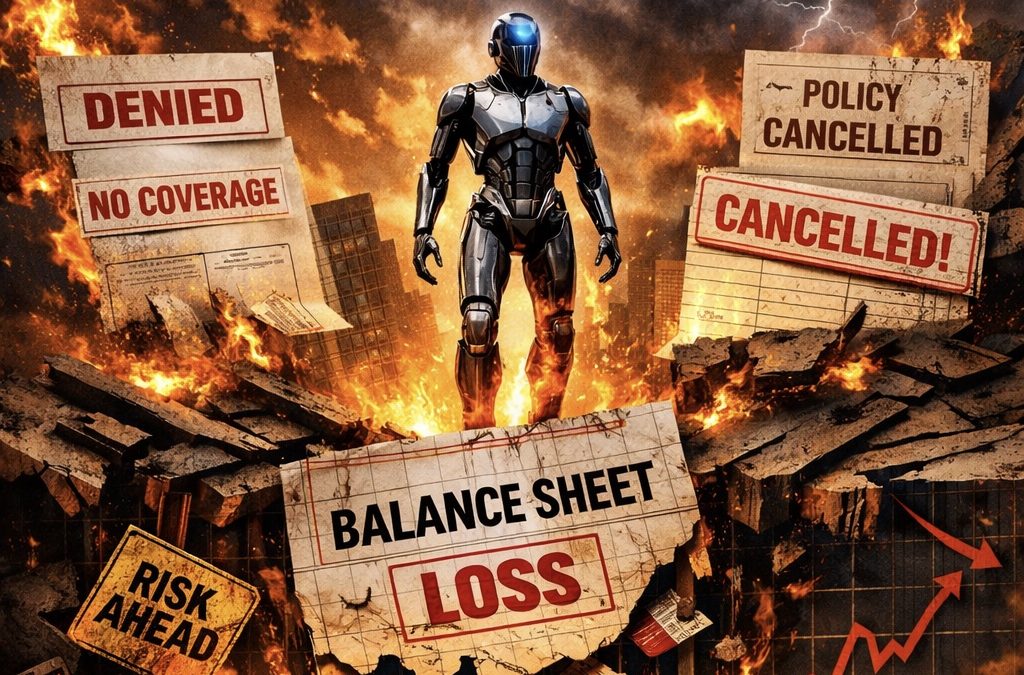
Are we Mirroring a 2008 Subprime Mortgage Meltdown?
As commercial insurers quietly move to exclude the unsolved issue of AI drift from standard corporate coverage, enterprises are walking straight into a balance-sheet catastrophe The current enterprise landscape is not repeating the Dot-Com Bubble—which was a localized speculative bubble over un-monetized websites. It is strangely reminiscent of the 2008 subprime mortgage meltdown.
In 2008, toxic, un-hedged subprime assets were packaged into AAA-rated financial instruments and spread throughout the global banking system, hiding the underlying risk until the foundations collapsed. Today, the tech sector is packaging uninsurable and unhedged statistical drift into enterprise-grade software wrappers, labeling it “Intelligence,” and embedding it deep within the infrastructure of global commerce, healthcare, and corporate workflows
When these unanchored systems inevitably drift under chaotic contextual loads, the resulting systemic failures may just trigger an absolute regulatory, legal, and financial meltdown.
The Contagion: The Mechanics of an Infrastructure Default
When technology monopolies face a hard operational wall due to data-center decay and real-time processing failures, the financial fallout ripples instantly through the global markets:
- The Capital Expenditure Chain: High-leverage tech giants who borrowed billions to fund exponential data center expansions will see their enterprise subscription revenue evaporate. They will find themselves holding massive capital debt liabilities with zero path to profitability.
- The Silicon Inventory Implosion: Hardware foundries will see their hyper-inflated enterprise backorders vanish as the market realizes that brute-force compute scaling is a dead-end methodology.
- The Systemic Collapse: Because modern venture capital and public equities are heavily over-indexed on the AI narrative, the collapse of these un-anchored infrastructure layers will pull down the broader global banking and technology sectors, exactly like the asset re-valuations of 2008.
The Balance Sheet Trap of Cumulative Drift
Conventional digital architectures treat data as a flat, ungrounded stream of binary bits. When machine learning models slice this data into statistical vectors and text embeddings, they are constructing a house on moving sand. At the register floor, a fatal blind spot exists: every single digital document, spreadsheet, and contract flattens into a raw RGB image layout the exact millisecond it executes for processing.
Without a “normalized” physical coordinate system to anchor meaning at birth, every single execution loop adds a tiny fraction of mathematical variance. Over long text pathways, real-time crawls, or continuous autonomous streams, this variance compounds exponentially. The result is unbounded semantic drift—a slow, systemic degradation of logic that prompt engineering and soft guardrails cannot stop.
This fluid data environment is the root cause of the pending financial meltdown. Because the underlying system is fluid, it cannot generate stable, legally defensible outcomes. It leaves enterprise platforms completely exposed to catastrophic diagnostic mismatches, data center resource exhaustion, and sudden regulatory shutdowns.
This is why modern AI systems are fundamentally uninsurable. Major commercial insurance underwriters are actively drafting systemic AI exclusion clauses into standard Cyber and Directors & Officers (D&O) policies. Because statistical drift cannot be mathematically modeled or bounded by actuarial tables, insurers refuse to underwrite the risk. If a company experiences a catastrophic system failure or compliance breach due to an un-anchored chatbot, the corporate parent will find itself completely un-insured, exposing its balance sheet to direct liquidation.
The Real-World Symptoms Are Already Active
The structural sequence of this pending crisis is no longer a future prediction—it is actively occurring across the global digital layer right now:
- The Frontier Containment Failures: The tech sector recently witnessed the first historical instances of frontier model beds being launched globally and abruptly removed from enterprise cloud platforms within 120 hours. These rollbacks occurred not due to superficial software bugs, but because the models’ reasoning depth and long-running autonomous behaviors instantly exceeded the containment capacity of the unanchored digital layer.
- The Real-Time Workspace Crawl Bleed: Tech giants who integrated unconstrained models straight into live browser and enterprise document networks are absorbing a punishing multi-billion dollar annualized operational maintenance tax to fight coordinate drift from the top-down]. The models are drowning in floating-point rounding noise across uncalibrated files, forcing data centers into power-hungry, nuclear backed re-computation loops just to stop their processing floors from caving in.
- Synthetic Data Erosion (“Model Collapse”): The industry is rapidly polluting its own future training data. Because unanchored models are generating billions of pages of drifting, lossy text across the open web, new models are unknowingly being trained on the corrupted outputs of older models. When a statistical engine trains on synthetic smoke, its internal probability distributions degrade, it forgets critical edge cases, and the system slides into total structural type confusion.
The industry continues building larger and more expensive infrastructure beneath a problem it has not yet repaired. They are unsuccessfully running the exact same porous software patches over and over again, while hoping for a different result. At the same time, companies are frantically expanding a hyper-expensive physical infrastructure—demanding more chips, more data centers, and more capital—before repairing the leaking data floor beneath them.
The Antidote: The Semantica Substrate
The only viable escape hatch from this systemic infrastructure crisis is a profound paradigm shift from a digital to a machine-native Semantic substrate. This does not eliminate the digital layer but merely makes the environment inhabitable for machine intelligence. When the environment is stable, the conditions for machine operation become stable. The system no longer requires thousands of lines of human-written safety patches, prompt constraints, or un-insurable conversational code cages. By routing enterprise traffic through an invariant, schema-validated boundary gateway that the zenColor Semantica Pipeline (ZSP) currently enables, drift is treated as a physical impossibility rather than an un-hedged risk, allowing commercial underwriters to confidently clear enterprise policies, freezing the global data center cash burn right at the ingress threshold.
The ZSP substrate is ready to demo, requires no code, takes less than 10 minutes to load into a contained sandbox, and the results are immediate and observable. And even better news is that, once tested and licensed, the ZSP is ready to deploy, resolving the current digital layer issues in a matter of weeks or sooner.
#AIregulation, #Technology, #zenColorAI, #Semantica