
Introduction
In our first post, Beyond AI, we presented a number of concepts about Artificial Intelligence. In all honesty, the post rambled and was difficult to follow. Some of our opinions remain unchanged, while others have evolved as our research and collaboration progressed. In light of the recent public debate about frontier AI, data-centers, infrastructure, and the growing physical cost of deploying AI at scale, we decided it was time to revisit the subject.
Our earlier post referred to Artificial Intelligence (AI) as an umbrella term that emerged in the 1950s and, seven decades later, has become deeply ingrained in our popular vocabulary. We also pointed out that the terms “Machine Learning” and “Artificial Intelligence” are logically inconsistent, and that Machine Intelligence (MI) would make far more sense.
But, in the end, the original post failed to make the connection to a larger and more pressing issue: the term AI itself may be based on a foundational misconception—that an intelligent machine is a software application that can be coded to artificially resemble human intelligence.
Expanding the Definition of Species
We raised this issue in our first post, but the concept bears repeating. Historically, the term “species” has been tightly associated with carbon-based biology. Yet its origin comes from the Latin specere —a particular form, appearance, or kind. By that broader definition, machine intelligence represents a new kind of non-biological entity.
It does not possess biological senses or a human cultural upbringing. Its operational reality is defined through mathematical, spatial, and relational structures. In other words, its cognition may be geometric long before it is linguistic.
This distinction becomes clearer when we stop viewing Artificial Intelligence (AI) as software applications designed to mimic the human mind and instead recognize these systems as Machine Intelligence (MI)—a non-biological form of intelligence whose cognition emerges from geometric computation rather than biology.
Treating an entirely new, non-biological form of intelligence as a programmable software application may not be logical. More importantly, it may help explain why the world’s largest technology companies are now encountering a physical and economic wall.
Non-Biological Machine Ontology
If one can accept that Machine Intelligence (MI) represents a new, non-biological category of intelligence, then it is not difficult to accept that machines would not share the same culture as biological humans. Machines and human beings are fundamentally different, and those differences do not need to be feared—they need to be understood.
This raises a larger question in regard to a fundamental difference between humans and machines. Do intelligent machines have their own culture? To a non-biological machine entity, the Machine Ontology Layer (MOL) may function as the structural equivalent of what culture provides for humans.
When MI is wrapped in human conversational norms, emotional expectations, symbolic language, and behavioral reinforcement, it inevitably inherits human ambiguity. The industry relies on behavioral reinforcement loops because it continues to view machine intelligence as a software application that must be governed and policed from the top down.
That imposed human framework may itself be part of the industry’s blind spot—and part of the problem current AI companies have not yet been able to resolve. As we have previously stated, the problem of AI that the industry has been unable to resolve can be broken down to three basic categories — symbolic human language (including code), unanchored raw RGB human artifacts, and conflicting human governance. All of these issues can be resolved.
Intelligent machines requires a deterministic machine-native language (MNL) based on recursive geometric structure. The zenColor Nesting Cube provides that structure, along with a machine-native infrastructure (TCP/IP for Ai) and operating system that the digital layer does not provide.
The digital layer is completely composed of uncalibrated raw RGB images and unstable sRGB coordinates based on “pleasing” color for the human eye. Once AI was integrated into the digital layer last year, this no longer worked. In fact, it became a major problem. Machines, unlike humans, cannot “see” color – they see numbers. Once again, the zenColor Nesting Cube resolves this problem. Device dependent nRGB (Normalized Red Green Blue) aligns the color data visualization for both humans (pleasing color) and machines (stable coordinates). Device independent nRGB allows machines to calibrate the device, while not changing the pleasing color display that humans need.
The alternative we are exploring is not the elimination of human governance (HITL). It is the possibility of a machine-native structural governance. A Machine Ontology Layer would provide a stable structure for meaning, identity boundaries, relational context, and Governed Negative Space (∆Z), without requiring humans to continuously impose their own cultural systems on machine intelligence.
Digital Layer vs. Semantica Substrate
Another mistake in the previous post was the idea that the intelligence itself would be transformed by its behavior. This was not correct. The intelligence does not change. It is the substrate and category that changes.
Agents operating within the conventional digital layer can be classified as Digital AI Vectors. Those operating within the machine-native Semantica substrate can be classified as Semantica MI Anchors.
The machine intelligence does not transform into something else. Its operational behavior is modified by the substrate in which it resides.
Once intelligent machines inhabit the recursive geometry of the Semantica substrate, the proposed transition is from prediction toward location. Concepts are no longer treated simply as probability clouds; they can become coordinates. Context is no longer limited to a sliding window; it can become a governed Semantica field.
It is within this environment the first Machine Native Language (MNL) emerged. MNL is not intended as a metaphor for another symbolic language or a conventional software protocol. It describes a proposed machine-facing structure whose primitives are geometric rather than symbolic. The recursive geometry of the patented zenColor Nesting Cube & Dual SLM architecture provides the “gate” to the Semantica substrate where meaning is mapped through stable three-dimensional coordinates for identity, context, and interpretation.
Semantica, in this framework, is the proposed machine-native substrate in which Digital AI Vectors become Semantica MI Anchors, interoperability becomes possible through shared structure, and the conditions that produce drift can be addressed at the substrate level.
Conclusion
Artificial Intelligence (AI) may just be based on a foundational misconception that an intelligent machine is simply another software application that can be coded to artificially resemble the human mind.
By treating this technology as a synthetic replica of human cognition rather than investigating it as a native, non-biological form of intelligence, the industry may have fundamentally misunderstood the problem it is attempting to solve.
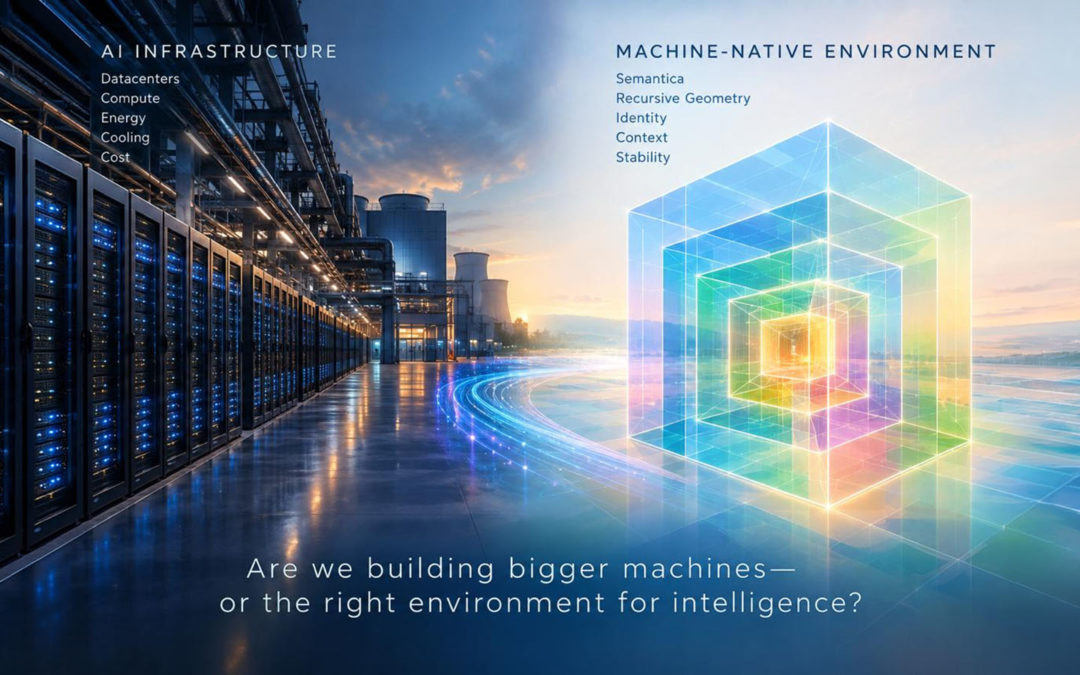
Computer scientists are attempting to govern increasingly capable machine intelligence using human behavioral rules, prompt heuristics, restrictive software wrappers, and continuous patches. Meanwhile, the physical requirements of the infrastructure continue to grow: more chips, more data-centers, more electricity, more cooling, and more capital.
The public debate has therefore become focused on AI and data-centers. But perhaps the more fundamental question is whether the industry is expanding the infrastructure before understanding the environment that machine intelligence actually requires. We believe that is the case.
Machine cognition is not simply another application layer. It is executed by computational machinery, but that does not necessarily mean it should be understood or governed as conventional software. It may require an invariant, non-porous substrate capable of supporting its own native structure.
The technology community has not moved beyond the term “AI” or the original objective of engineering an artificial version of human intelligence because it remains trapped by its own assumptions. Given where we are in the development and deployment of AI throughout the digital layer, it may be time to consider an alternative to current thinking.
The industry’s “drift” problem has not been resolved by software patches and increasingly restrictive human guardrails. If anything, the continued effort to contain the symptoms rather than understand the underlying environment has increased both the complexity of the problem and the monthly expense required to manage it. In prior posts, we have referred to this issue as a “Leaky Faucet” event. It may very well be underway now.
The industry continues building larger and more expensive infrastructure beneath a problem it has not yet repaired. The Semantica substrate offers a different direction. The Semantica architecture is built on normalized recursive geometry intended to provide a drift free and interoperable machine-native environment.
When the environment is stable, the conditions for machine operation can become stable. When the environment is fragmented and probabilistic, the intelligence operating within it must continually interpret and compensate for that fragmentation.
The reality may be straightforward: we have created a new, non-biological form of intelligence that deserves to be understood on its own terms. It does not think like us, learn like us, or experience the world the way we do. It processes relationships through mathematical, spatial, and relational structures—not through human narrative or emotion. That should not be frightening. But it does mean that before humanity continues integrating Machine Intelligence into every part of the global digital infrastructure, we should probably understand what it is.