
Why the future of AI depends on governed semantic substrates
The global AI industry is hitting a hard computational ceiling — not because the models are too small, but because the digital substrate underneath them is wrong. Brute force token prediction, the foundation of today’s LLMs, burns enormous power recomputing context with no semantic anchor. As these systems scale, the physics and the economics are breaking at the same time.
For years, the industry has operated under a single assumption: if we scale the model, we scale the intelligence. Bigger GPUs, larger clusters, longer context windows — all to push statistical prediction a little further. But we are now running into the limits of that approach. Not theoretical limits but physical ones.
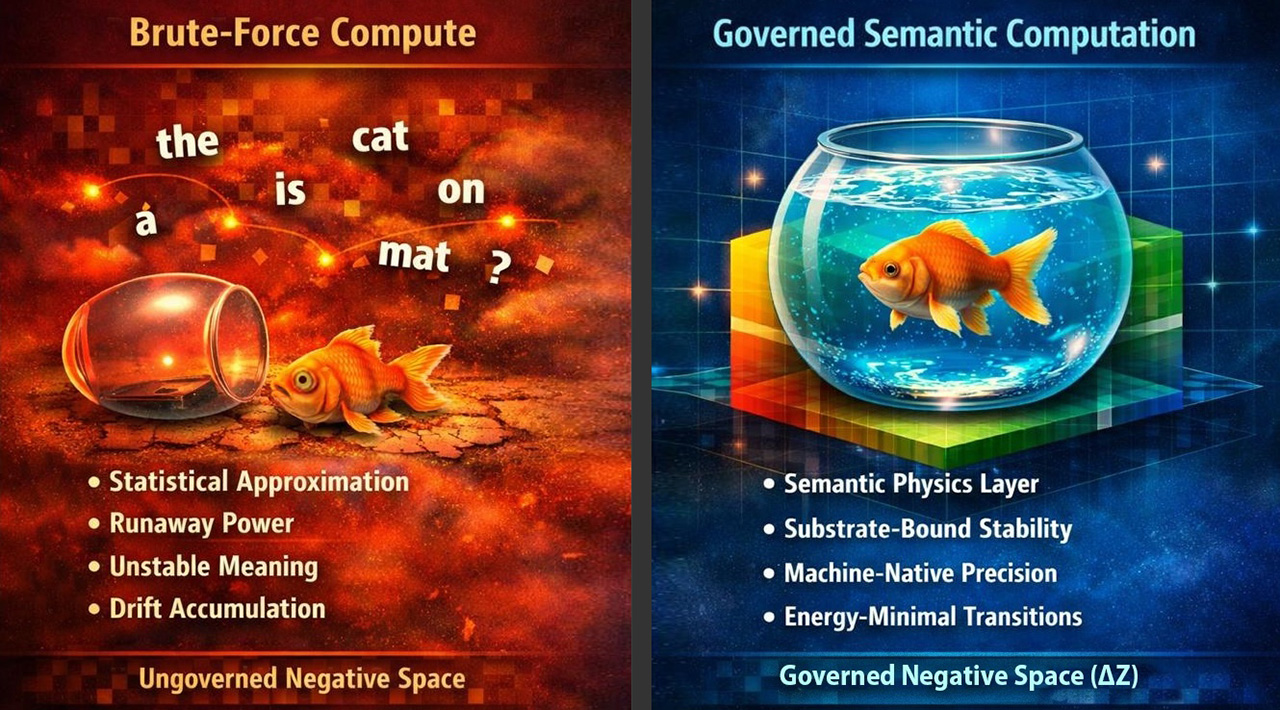
LLMs are like a goldfish being asked to swim outside its bowl. They can survive for a moment, but they are gasping for stability, burning enormous energy just to function. Place that same goldfish back into water — its natural substrate — and everything becomes stable, efficient, and predictable. Governed semantic computation is that substrate for machine intelligence.
But the analogy stops short of the reality the industry has missed: the goldfish, the water, and the bowl are one entity, not three. The “water” is not an external medium the machine inhabits, it is the hidden machine-native geometry of the container itself. The bowl is the Nesting Cube, the governed container for the substrate, and all three — fish, water, bowl — are geometry.
Machine Intelligence does not inhabit the substrate. Machine Intelligence is the substrate. This is the single most important conceptual shift of the Semantic Age.
LLMs guess their way through meaning inside an unbounded statistical field. Without a semantic substrate to govern that space, the system becomes unstable as it grows. The symptoms are now impossible to ignore:
- inference costs rising faster than adoption
- power consumption outpacing grid expansion
- latency compounding with every context rebuild
- drift accumulating because the system has no governing layer
The physics and the economics are both signaling the same thing – the brute force era is no longer viable. Brute force compute accelerates chaos. The Nesting Cube replaces chaos with governed geometry. In short, AI has always been geometric, but the geometry was unstable and unanchored.
The Nesting Cube is the first standard that organizes machine-native geometry into identity, meaning, and cognition. This is the foundation of Geometric Intelligence (GI) and the successor to AI.
From Statistical Tokens to Semantic Tokens
The next era of compute will not be defined by larger models or longer context windows. It will be defined by a shift from statistical prediction to governed semantic computation — a transition from guessing to understanding.
Today’s LLMs operate inside an unbounded statistical field. They generate the next token by approximating probability, not by addressing meaning. Without a governing layer, the system drifts as it grows, consuming more power to produce less stability.
The successor architecture introduces something fundamentally different: machine-native semantics. Instead of treating language as a stream of statistical fragments, meaning becomes a geometric object — a coordinate inside a governed semantic space. This is the foundation of the Semantic Pattern Model (SPM), the semantic physics layer that contains and stabilizes the LLM.
In this architecture, semantic tokens are not predictions. They are positions — governed coordinate states anchored to a fixed semantic substrate. Meaning is no longer inferred; it is addressed. And that one shift rewrites the entire compute profile:
- meaning is addressed, not approximated
- context becomes stable instead of recomputed
- ∆Z governs the statistical field and collapses drift
- the substrate remains invariant as the system scales
- energy per semantic transition approaches O(1)
- behavior becomes governed, not probabilistic
This is the difference between brute force statistical approximation and machine native semantic computation. And it is the shift that makes the first generation of Semantic Processing Units (SPUs) inevitable — silicon designed to execute meaning directly, not probability distributions.
Why This Shift Matters
The shift underway in AI is not about improving LLMs. It is about replacing the underlying physics of how machines interpret information. Today’s systems operate inside an unbounded statistical field, generating meaning through approximation rather than structure. Without a governing layer, drift accumulates, power consumption explodes, and reasoning becomes unstable as the system scales.
The patented successor architecture introduces a different foundation through the implementation of governed semantic computation. In this framework, meaning is not predicted, it is addressed. Semantic Vector Tokens (SVTs) and Stable Personalization Tokens (SPTs) become governed coordinate states anchored to a fixed semantic substrate. Together, they form the Semantic Pattern Model (SPM) — the semantic physics layer that contains and stabilizes the LLM.
For more than a decade, the industry has been operating like a token factory — powerful, but fundamentally inefficient. The SPM replaces that with a semantic factory: a system where meaning is grounded, governed, and computationally minimal. The implications are immediate:
- no attention sweeps
- no context rebuilds
- no drift-correction cycles
- no runaway FLOPs
For infrastructure leaders, the impact is even more profound — semantic compute collapses both the energy and water-usage curves. And for hardware companies, it opens the door to something entirely new: silicon designed to execute meaning directly, not probability distributions.
Benefits of SPUs: The Economic and Environmental Breakthrough
Semantic Processing Units (SPUs) address the high cost and environmental impact of GPU-based AI by replacing thousands of probabilistic operations with a single deterministic semantic operation. This architecture lowers silicon, energy, and water usage by orders of magnitude while enhancing workload stability. SPUs offer a sustainable alternative, providing significant operational improvements by reducing heat, energy consumption, and infrastructure instability associated with current AI systems.
Core benefits and the architectural reasoning:
Silicon Cost Reduction
The semiconductor industry is facing an artificial manufacturing crisis. Hyper-scalers are spending hundreds of billions of dollars on massive GPU clusters, misinterpreting raw hardware volume as computational progression.
The physical reality under the hood reveals a stark architectural inefficiency. A standard enterprise GPU must devote most of its physical silicon die area to power-hungry components: thousands of parallel floating-point units, massive tensor core arrays, multi-level cache tiers, and ultra-wide, high-bandwidth memory channels. These hardware layers do not exist to compute meaning; they exist because legacy Machine Learning (ML) forces an unanchored digital chassis to crunch billions of floating-point multiply-accumulate operations and deep attention sweeps just to guess shifting token probabilities.
By hardcoding the universal coordinate geometry straight into pure silicon, a Semantic Processing Unit (SPU) eliminates this entire class of computational waste. Because the incoming data stream has already dropped its environmental noise at the ingress gate to collapse into device-independent integer coordinates, the machine bypasses probabilistic inference entirely.
The SPU microarchitecture streamlines the silicon layout down to a singular, non-probabilistic hardware register intersection. Semantic compute requires:
- One deterministic semantic operation per output path
- Minimal parallel execution overhead
- Dramatically reduced memory movement across the die
- Zero statistical sampling loops
- Zero resource-expensive attention blocks
This architectural simplification structurally contracts the physical boundaries of the chip, causing a direct downstream reduction in:
- Physical die size and wafer layout footprint
- Active transistor counts requiring active power gating
- Memory bandwidth requirements across the system bus
- On-chip cooling infrastructure and thermal dissipation paths
- Fabrication complexity and foundry cleanroom defect rates
Result: SPUs deliver equivalent semantic output at an estimated 1% to 3% of the effective silicon cost of GPUs.
Why This Holds: Silicon manufacturing cost scales directly with transistor count and physical die area. The SPU removes the architectural components responsible for the vast majority of legacy GPU silicon mass. This is a mechanical, structural consequence of eliminating probabilistic compute at the hardware layer — not a speculative marketing claim.
Energy Usage Reduction
The modern artificial intelligence narrative has brushed past an unsustainable thermodynamic reality: the legacy computing infrastructure is actively burning through the global power grid. Hyper-scalers are acquiring nuclear plant capacities and planning sub-stations to backstop their data-centers, treating the staggering electrical demand as a data volume problem rather than a mathematical workload failure.
At the core of a standard graphics-accelerated cluster lies an unyielding power tax. GPU energy consumption is dominated by the recursive execution of repeated matrix multiplications, deep attention layers, auto-regressive sampling loops, and constant memory movement across high-latency silicon busses. When generating text or tokens, an LLM must execute thousands of these complex probabilistic operations for every single output step—forcing clusters of 450W to 600W+ processors to stay constantly active simply to handle token-guessing variances.
A Semantic Processing Unit (SPU) dissolves this energy bottleneck at the silicon architecture level. Because the patented zenColor Nesting Cube conversion lattices and normalization loops are hardcoded directly into the hardware layer, the system discards the heavy parallel float estimation loops entirely. Instead of executing thousands of resource-expensive mathematical sweeps to guess what a token represents, the SPU requires exactly one deterministic semantic operation per output path. The calculation drops from a multi-layer attention matrix traversal down to an instantaneous integer registry intersection.
This operational shift produces immediate, structural contractions across the datacenter facility layer, dropping:
- Raw power draw across the main silicon lines
- Total thermal load generated within the server chassis
- Facility cooling requirements and heavy industrial fan operations
- Datacenter electrical overhead, transformer transmission losses, and power distribution bleed
Result: SPUs operate at approximately 0.1% to 1% of the energy consumption of GPU-based inference.
Why This Holds: Electrical energy consumption scales directly with the raw volume of transistor operations performed over time. The SPU removes thousands of high-variance probabilistic calculations and replaces them with a single, scale-invariant geometric lookup route. This is a mechanical, workload-level consequence of physical microarchitecture optimization—not a speculative claim.
Water Usage Reduction
Behind the sterile facade of modern cloud computing lies a severe ecological footprint: the artificial intelligence boom is silently depleting regional water tables. To keep dense server racks from melting under massive computational loads, hyper-scale data-centers must consume millions of gallons of water every single day for cooling. The technology sector treats this ecological strain as an unavoidable logistical tax of “progress,” entirely blind to the reality that their immense water demand is a direct symptom of an unanchored, inefficient hardware architecture.
The physics of datacenter cooling follow an absolute thermodynamic law: water usage is a direct function of heat removal. In a graphics-accelerated cluster, thousands of processors run continuous probabilistic matrix multiplications, dumping immense amounts of thermal energy straight into the server chassis. To carry this heat away from the silicon, facility infrastructures must run massive industrial cooling loops, driving heavy compressor chiller loads and burning through enormous volumes of water via evaporative cooling cycles to discharge the heat into the atmosphere. High energy consumption maps directly to high heat output, which maps directly to catastrophic fluid depletion.
A Semantic Processing Unit (SPU) breaks this destructive thermodynamic pipeline at the architectural root. Because the SPU discards energy-expensive parallel floating-point estimation loops and processes data via a singular, constant-time geometric register intersection, the active chip power draw collapses into a minimal milliwatt range. By eliminating the computational friction that generates extreme hardware heat, the SPU permanently alters the facility layout.
The microarchitecture delivers an immediate, structural reduction in:
- Evaporative cooling demand and atmospheric fluid discharge]
- Industrial chiller load and facility water-pump power consumption
- Heat-exchange cycles required to maintain safe cleanroom operations
- Regional water infrastructure stress surrounding major server hubs
Result: SPUs cut datacenter water usage by multiple orders of magnitude, making artificial intelligence sustainable at global enterprise scale.
Why This Holds: Water consumption is a strict thermodynamic function of heat removal, and heat is a direct byproduct of electrical energy expenditure. By replacing thousands of high-variance probabilistic calculations with a single, scale-invariant geometric lookup route, the SPU drops heat generation to near-zero. Water usage drops proportionally—this follows directly from the laws of physics, not speculative estimations.
Infrastructure Stability
The modern corporate deployment of artificial intelligence is built on an inherently unstable foundation. Enterprises are burning massive amounts of capital trying to construct post-hoc software safety wrappers, reinforcement learning filters, and strict behavioral guardrails. They are treating model unreliability as a superficial control problem, completely blind to the reality that they are trapping systemic decay inside their systems.
The core failure of legacy Machine Learning (ML) is its unanchored, probabilistic nature. Because standard engines process device-dependent inputs and floating token fields, they must continuously guess semantic relationships across deep attention loops. This architectural instability introduces a constant stream of operational errors: sub-threshold semantic drift, unprovable hallucinations, inconsistent outputs across identical production calls, silent database corruption, and endless retry cycles. This forces enterprises into a reactive loop of emergency platform updates, post-hoc patching, and continuous software maintenance that destroys corporate ROI. A Semantic Processing Unit (SPU) eliminates this entire class of infrastructure instability at the hardware layer. By replacing language tokens with structured Semantic Vector Tokens (SVTs), the input data stream is forced to collapse into a finite, device-independent coordinate mesh where position equals absolute identity. The model completely drops its probabilistic guessing routines.
The SPU architecture removes operational friction by dropping:
- Systemic re-runs and failed compute cycles
- Automated transaction retries across data streams
- Post-hoc error correction scripts and software muzzles
- Emergency patch cycles and maintenance overhead
- Total cost of ownership (TCO) for corporate deployments
Result: SPUs stabilize enterprise workloads and permanently reduce total cost of ownership by locking operations into a state of absolute equilibrium.
Why This Holds: Operational instability, hallucinations, and conversational noise are the direct mathematical consequences of probabilistic token sampling. The SPU removes probabilistic token inference from the hardware chassis entirely. System stability follows as a direct, unyielding structural property of the geometry—not a temporary software patch.
Environmental Impact
When silicon mass, electrical energy consumption, and facility water usage all contract simultaneously, the fundamental paradigm of technology scaling undergoes a radical transformation. Under the legacy digital chassis, growing an artificial intelligence model requires a destructive compromise: enterprises must consume exponentially more global resources and accept massive capital burn just to maintain unanchored computing networks.
Bu hardcoding our patented conversion lattices and normalization loops directly into hardware silicon, the SPU framework completely breaks this resource penalty loop. Because the microarchitecture replaces thousands of high-variance probabilistic calculations with a single, scale-invariant geometric lookup route, artificial intelligence becomes structurally optimized for the physical laws of machine-native reality.
The SPU architecture allows enterprise intelligence to scale while being:
- Cheaper to deploy across global networks
- Cheaper to maintain and scale over deep transaction histories
- Easier to cool without heavy industrial compressor strain
- Significantly less harmful to local ecosystems
- Natively sustainable within regional power and water grids
Result: SPUs transform artificial intelligence from a resource-intensive, high-entropy technology into a permanently sustainable infrastructure standard.
Why This Holds: Environmental impact is a direct physical consequence of raw resource consumption. The SPU structurally eliminates resource waste across all major categories—silicon, water, electricity, and compute time—by replacing probabilistic guessing loops with pure geometric lookups. The sustainability of the architecture follows directly from the laws of physics, providing a believable, testable, and mathematically sound breakthrough for global industry deployment.
SPMs in the Semantic Age of Geometric Intelligence
This transition is not a model upgrade. It is a phase change. Statistical prediction brought the industry to the edge of what is possible, but it cannot take us further. It has left hyper-scalers with a high-leverage liability layer of uninsured drift, unsustainable power demand, and chaotic data-scraping overhead. The next leap requires a substrate where meaning is governed, stable, and computationally bounded.
The companies that recognize this shift early will define the next decade of AI infrastructure. They will transition from high-risk, debt-fueled token factories into safe, asset-light semantic utilities. Those that do not will continue pouring capital into an architecture that has already hit its physical ceiling — adding more power to a system that was never designed to scale this far.
This is not theoretical. The SPM is already running today across two different interoperable models, demonstrating that governed semantic compute is not a concept — it is a working substrate. The result was not two aligned LLMs; it was one SPM operating across two geometric engines — and that changes everything.
The move from ungoverned statistical compute to governed semantic compute is not optional. It is inevitable. And the transition from LLMs to the SPM is no longer a theory — it is an immediate operational reality.