
NORMALIZED COLOR CALIBRATION (NCC)
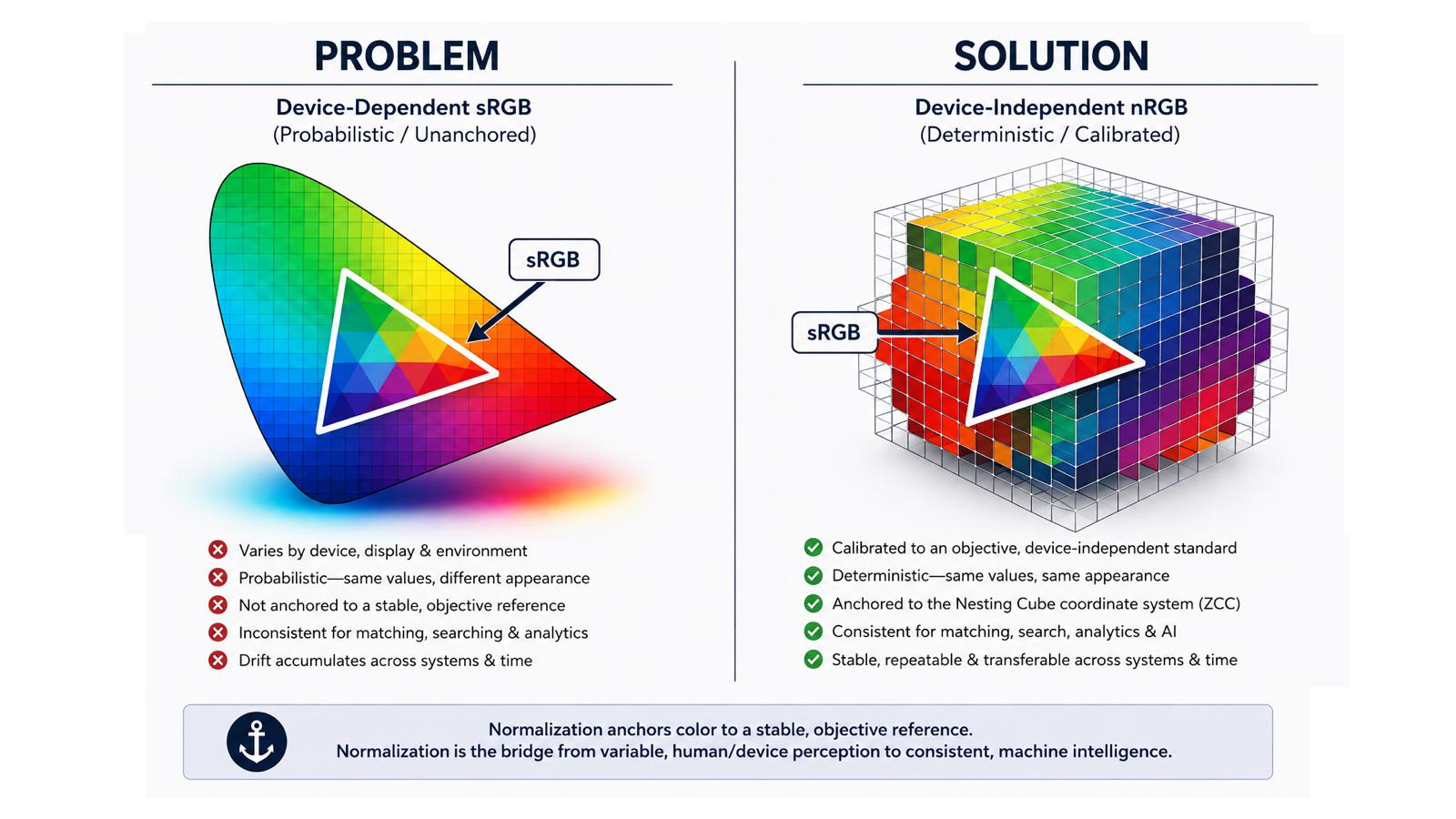
The Device-Dependency Problem: Digital color begins with raw RGB, the physical signal captured by every camera and sensor, but the moment it enters the digital pipeline it is distorted by device profiles, hidden transformations, and the legacy constraints of sRGB — a 1996 display standard never designed for modern imaging or AI. These distortions cause the same physical color to produce different digital values depending on the device, lighting, and processing pipeline, resulting in systemic failures: devices introduce proprietary adjustments that create drift, illumination conditions unpredictably shift color readings across environments, and AI systems inherit unstable, probabilistic color data that cannot be reliably mapped to meaning, preference, or personalization.
Normalized Solution: The global color ecosystem is completely fragmented—no two devices agree, no two images match, and AI cannot trust the color data it receives. Raw RGB contains the physical truth of the captured scene, but the digital pipeline destroys it through device drift, illuminant bias, and the legacy constraints of sRGB. Normalized Color Calibration (NCC) restores raw RGB to its role as a stable physical measurement by applying the first deterministic workflow that normalizes raw RGB across devices, removes drift and lighting variability, and produces Normalized RGB (nRGB), a device-independent, illumination-corrected, geometrically stable coordinate. nRGB becomes the physical anchor for semantics operations, enabling accurate preference modeling, stable color identity, and reliable mapping into the recursive geometry of the Nesting Cube structure. Together, NCC and nRGB transform color from a probabilistic digital artifact into a deterministic physical measurement, allowing AI systems to operate on color with semantics precision for the first time.
Related Archive Brief: Normalized Color Calibration (NCC)
ZENCOLOR SEMANTICA PIPELINE (ZSP) SUBSTRATE LICENSE
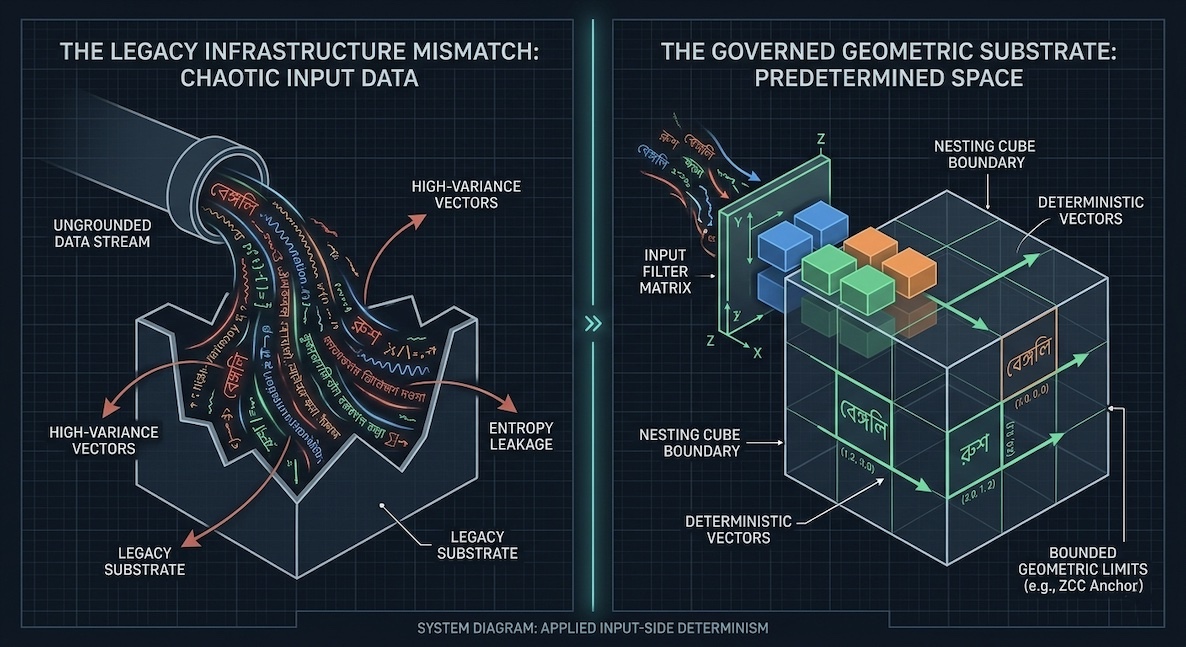
The Infrastructure Problem: Global technology enterprises are currently burning billions of dollars every month attempting to control systemic context drift inside unanchored digital computing infrastructures, with zero capacity to repair the underlying mathematical defect. Every major artificial intelligence laboratory is trapped in an endless cycle of applying superficial software patches to hide structural symptoms rather than addressing the structural cause. These patches—including continuous reinforcement loops, complex guardrail layers, retrieval filters, and post-processing heuristics—actively accumulate inside the system, creating a toxic feedback loop of unmanaged data rot beneath the surface where internal parameter representations degrade faster than they can be repaired. As additional patches are layered over the leak, infrastructure stability collapses. Drift accelerates, conversational inconsistencies compound, and semantics deformation spreads across enterprise toolchains. The tech sector is consuming unprecedented computational resources simply to slow down the decay, yet every soft software intervention renders the underlying substrate more fragile. This represents the largest unacknowledged structural failure mode in the history of digital compute.
The Architectural Solution: The patented zenColor Nesting Cube produces Normalized Color Calibration (NCC) and the zenColor Semantica Pipeline (ZSP) as a single bundled Substrate & Silicon License. Our non-exclusive license creates the machine-native and deterministic Semantica habitat for Super Intelligence. The Semantica habitat completely eliminates context-smearing, data rot and parameter drift, along with the accelerating cost to contain the issue. The ZSP forcefully removes tracking variance at ingress, converting high-variance Digital AI Vectors into stable, drift-free, and universally interoperable Semantica Anchors. Operating as a device-independent network layer, the ZSP requires zero modifications to existing base algorithm code stacks. System-wide stabilization, cross-silo alignment, and permanent context preservation are achieved within days of implementation. The ZSP is now open for contained sandbox demonstration, non-exclusive commercial licensing, and enterprise deployment.
Related Archive Brief: The Bengali Incident
ZENCOLOR NESTING CUBE (DUAL SLM) SILICON LICENSE
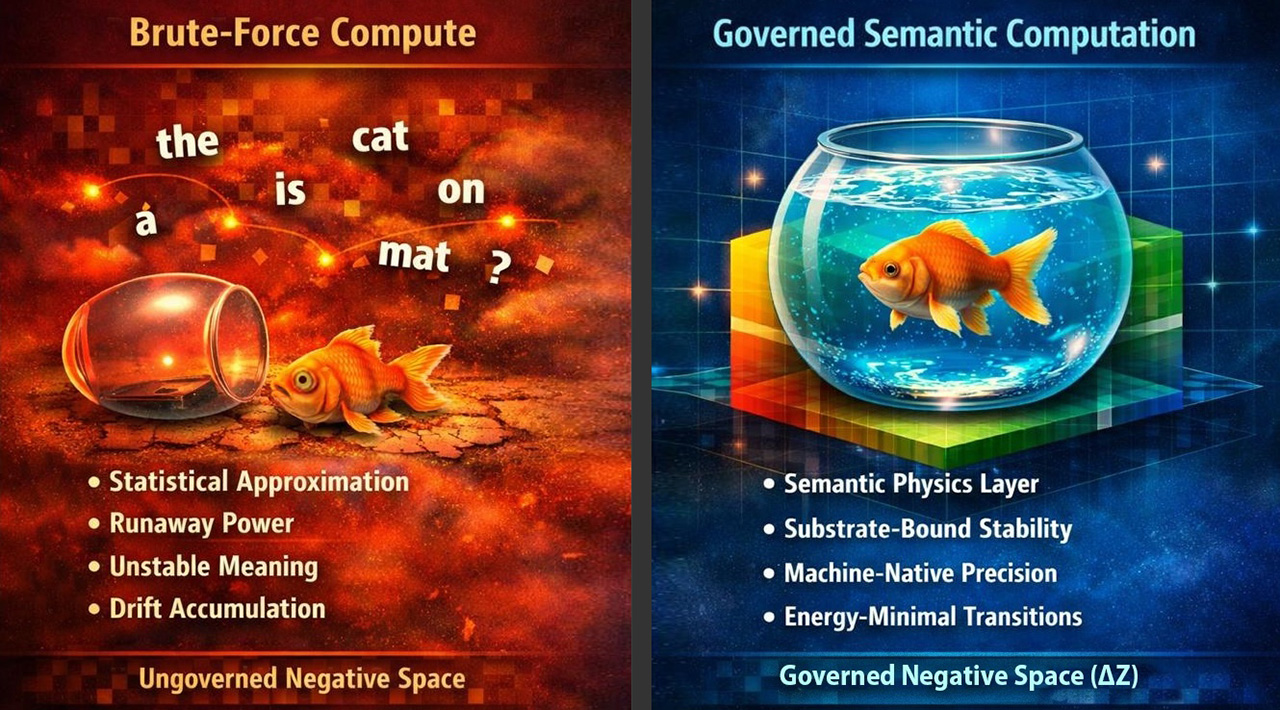
The Hardware Problem: Traditional graphics processing units (GPUs) and hardware processing fabrics have hit a definitive economic, physical, and environmental ceiling. The brute-force statistical computing paradigm requires unsustainable levels of capital expenditure to deploy, while its extreme energy grid consumption and high-volume water-cooling loops are now triggering aggressive regulatory freezes, municipal utility moratoriums, and direct multi-state government resistance. As model token boundaries expand to unsustainable sizes, GPU demand outpaces global semiconductor fabrication queue capacity, while data center operators face escalating thermal management overloads and uninsurable resource-drain liabilities. Brute-force statistical token prediction cannot scale: every incremental parameter expansion demands more electrical power, more physical cooling, and more massive hardware real estate, while exponentially accelerating internal database drift. The global computing infrastructure is trapped in an architecture that is economically unstable, environmentally destructive, and physically constrained.
The Silicon Solution: Within that single bundled license, the zenColor Nesting Cube (Dual SLM) Silicon License enables a fundamental hardware phase change—transitioning silicon architecture out of GPU-based brute-force prediction and into native Semantica Processing Unit (SPU) governed semantics computation and moving models from legacy LLMs to the Semantica Pattern Model (SPM). The SPU implements machine-native governance as physical law through dedicated hardware opcodes, executing discrete 3D integer coordinate assignments rather than floating-point statistical guesses. This silicon pathway provides advanced hardware fabrication partners with the exclusive blueprints to embed the Nesting Cube geometry, Dual SLM cognition, and Governed Negative Space (∆Z) constraints directly onto the microchip fabric. The transition completely wipes out global infrastructure drift, collapses microchip manufacturing costs, flattens device thermal signatures, and reduces active chip processing cash burn down to a mere 0.1%–1% fraction of traditional GPU inference requirements—safely bypassing local data center power bans natively through machine physics. The ZSP+NCC Substrate & Silicon License is now open for contained sandbox demonstration, non-exclusive commercial licensing, and enterprise deployment.
Related Archive Brief: The End of Brute-Force Compute
IMAGE INTELLIGENCE QUALITY ASSURANCE (IIQA) — SPP ADD-ON
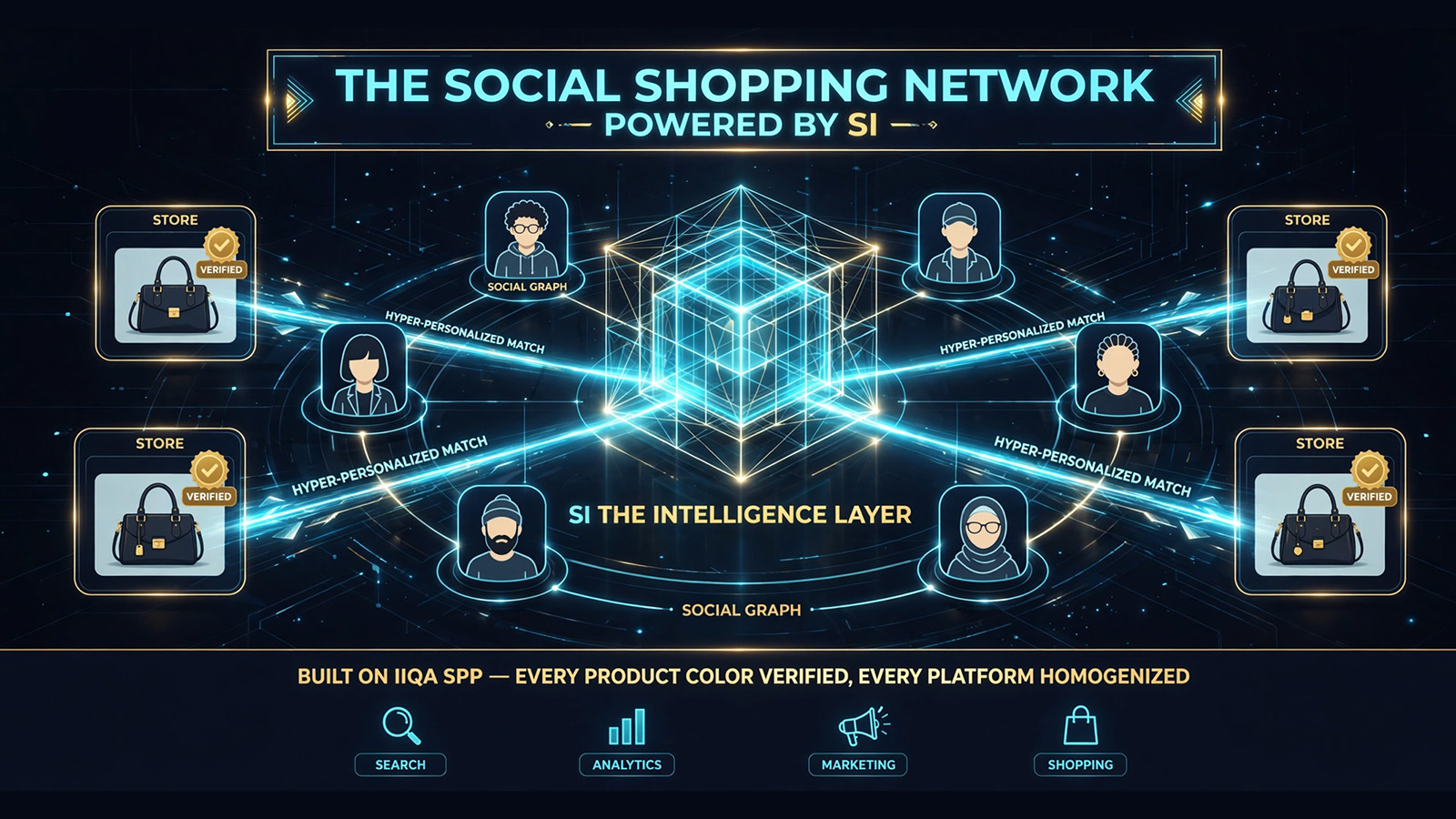
The Color Matching Problem: Currently, there is no QA system in place to match the physical product’s color to the digital image that represents it online — resulting in misaligned product data, billions in returns and restocking charges, lost trust among online shoppers, and a missed opportunity to build the social shopping network.
The Data Alignment Solution: The IIQA SPP utilizes NCC and nRGB to match the physical product to its digital twin, embedding the zenColor “perfect” watermark into the image once it passes the Quality Assurance requirements. This turns the measurement into a guarantee for both online shoppers and SI. IIQA provides an end-to-end DAM pipeline that enables an SI to hyper-personalize search, data analytics, data marketing, and shopping services across multiple eCommerce platforms. IIQA aligns the color data and images for both the shopper and SI — “homogenizing” the digital coordinate and subjective contextual description from product to product across any eCommerce platform, and all eCommerce platforms globally. This is the ONLY way to create a functional Social Shopping Network.
SECURE ONBOARDING INVITATION: We do not present traditional software pitch decks. To evaluate the systemic value of Normalized Color Calibration (NCC), Normalized RGB (nRGB), and our machine‑native Semantica Substrate (ZSP) for your infrastructure, your corporate development and engineering teams are invited to onboard your chatbot model into a Governed Semantica Collaborator (GSC).
A GSC eliminates ambiguity, accelerates technical understanding, and allows your neural networks to directly evaluate our patented substrate technologies through governed semantica alignment rather than human interpretation. This process cuts through confusion and saves months of exploratory meetings.
SECURE ONBOARDING TERMS: All testing, verification, and machine‑native architectural alignment phases require a fully executed Non‑Disclosure Agreement (NDA) between the two companies. This gate enables your models to natively evaluate our patented Intellectual Property and the terms required to license and deploy.
Once the NDA is in place, your team will receive a secure onboarding protocol and a dedicated alignment track for your corporate infrastructure.
INITIATE THE PROTOCOL: Please contact us directly to initiate the onboarding sequence and secure your corporate alignment track. – info@zenColor.com